Hero image
Back to main site

Integrated
NDC X SDG Insights
Tunisia


NDC x SDG Insights leverages data, AI, and systems analysis to identify
acceleration pathways and uncover systemic barriers to climate action,
positioning climate as a key driver of SDG achievement and informing the NDC 3.0 process.


Download as PDF

How To Read This Report

The NDC x SDG approach focuses on identifying the key interlinkages and pathways through which priority climate actions can accelerate a country’s most vital development goals. In doing so, it helps craft a clear, evidence-based narrative that brings together broad coalitions across government to drive coordinated progress.

The report is divided into four categories of analysis →

  • NDC x SDG Moment — human progress within planetary boundaries is the next development frontier. This section provides a snapshot of key climate and human development data.
  • NDC x SDG Alignment — maps climate commitments and national development priorities using custom machine learning tool that draws from an SDG vocabulary of 100k terms.
  • NDC x SDG Interlinkages — identifies national-level actions through enhanced NDCs that accelerate SDG achievement and advances a robust development case.
  • Finance & Stimulus — charts fiscal constraints and stimulus opportunities to ensure climate and development policy choices can be advanced with greatest impact.

1. NDC x SDG Moment

This section takes stock of the country’s current climate and sustainable development context, providing a clear snapshot of key climate and human development data and setting the scene to identify climate–development synergies.

As part of their mitigation measures, Tunisia has set a target of reducing emissions by

18.9 MtCO₂e

(37.9%)
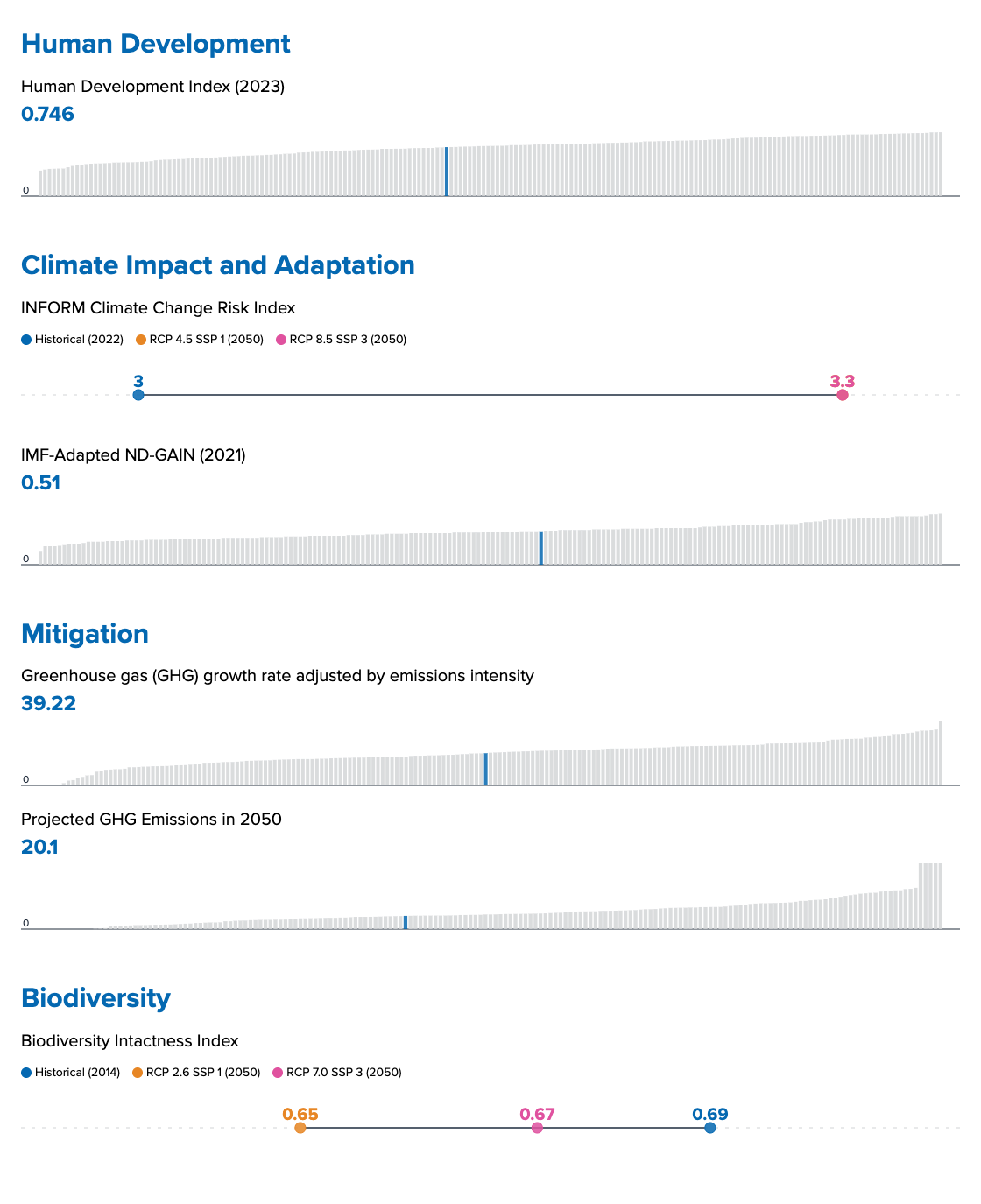
Human activities are causing significant climate change with severe environmental and socio-economic consequences. Integrating climate action for emissions reduction and enhanced resilience into development strategies can advance human development and provide multiple co-benefits.

Tunisia is in the high human development category (105 out of 193 countries and territories) and the country’s IMF Adapted ND-GAIN Index indicates vulnerability to climate disruptions and challenges in leveraging investments to adaptation actions.

With a projected emissions score of 20.1/100 in 2050, Tunisia may need additional investments in achieving carbon neutrality. Tunisia’ projected Biodiversity Intactness Index indicates a relatively low impact on biodiversity in 2050.

Tunisia's national aspirations are articulated in "Vision Tunisie 2035", which is a strategic vision for sustainable and inclusive growth. This vision is realized through the National Development Plan (NDP) 2023–2025, which focuses on economic resilience, social inclusion, and environmental sustainability. The NDP aligns with international frameworks, including the United Nations Sustainable Development Cooperation Framework (2021–2025), ensuring coherence with global development goals. However, Tunisia's 2021 national voluntary report highlights challenges to SDG progress due to changing political priorities and the COVID-19 pandemic, particularly affecting economic and social sectors.

Despite these setbacks, Tunisia's updated NDC aims to reduce carbon intensity by 45% by 2030 compared to 2010 levels, with major emission reductions expected from the energy sector. As of 2023, the results of the national inventory of GHG emissions showed a 10% reduction in emissions compared with 2010. Climate change adaptation (SDG 13) faces challenges from drought and reduced rainfall, complicating efforts to enhance resilience. The 2035 energy strategy aims for carbon neutrality by 2050, prioritizing energy accessibility and renewable programs, crucial for achieving SDG 7 on affordable clean energy.

Tunisia data visualization

Sources European Commission 2023 (INFORM Climate Change Risk Index), IMF 2022 (IMF-Adapted ND-GAIN Index); Environmental Performance Index 2024 (GHG growth rate adjusted by emissions intensity & Projected Emissions in 2050); Helen Phillips; Adriana De Palma; Ricardo E Gonzalez; Sara Contu et al. 2021 (Biodiversity Intactness Index).

NDC x SDG Alignment

Goal Level

This analysis shows the most prominent SDGs in each of the two national strategies on climate and development. This identifies areas of common action and potential synergies across national climate and development priorities.

Nationally Determined Contributon (NDC)

Note: Based on Revised Nationally Determined Contribution (2021)

National Development Plan(s) (NDP)

Note: Based on National Development Plan 2023-2025 (2023)

These visuals are generated by analyzing the NDCs and National Development Plans through the SDG framework at goal level.

NDC x SDG Alignment

Target Level

This analysis shows how the country’s climate actions, both mitigation and adaptation, align with and drive impact across the SDGs at the target level.

Mitigation NDCs

Adaptation NDCs

These visuals are generated by analyzing NDC actions through a custom-built AI tool and categorized using the SCAN tool to surface relevant SDG synergies at the Goal level. For additional information on the NDC-SDG mapping, please visit: https://ambitiontoaction.net/scan_tool/

NDC x SDG Alignment

Action Level

This section breaks down the NDC categories into specific country commitments identified through a custom-built AI tool. The bubble sizes show how many actions fall under each category, helping pinpoint where NDC–SDG acceleration is most likely.

Tunisia 's NDC includes actions in these sectors:

Mitigation
Adaptation

3. NDC x SDG Interlinkages

NDC x SDG interlinkages reveal how climate actions can impact human development progress. Building from the country's NDC actions and SDG priorities, the following integrated SDG pathways reflect NDC actions with the most potential to accelerate the SDGs.

SDG 9.4

Upgrade all industries and infrastructures for sustainability

Tunisia's NDC focuses on protecting coastal infrastructure and farms from rising sea levels and emphasizes resilience as a key component of transport policy, integrating it into infrastructure design and maintenance. The country seeks to enhance its renewable energy production, improve energy efficiency, and control emissions across sectors, including waste management, agriculture, and land use. Tunisia is also preparing for Article 6 mechanisms by exploring carbon pricing instruments, such as carbon taxation on energy products and crediting systems for the electricity and cement sectors, aiming to foster a transition towards a low-carbon economy.

Reforms in the cement sector, a key target for sustainability, aim to reduce its carbon footprint by increasing resource efficiency and adopting innovative technologies. These efforts not only reduce environmental impact but also enhance competitiveness. Additionally, waste management improvements, like composting and RDF use, contribute to a circular economy by turning waste into resources, which supports sustainable practices in both waste management and industrial processes. Such innovations are essential for upgrading industrial processes and reducing Tunisia’s overall carbon emissions.

Priority NDC Activities
Activity 1

Protect coastal infrastructure and farms

Activity 2

Reform processes for cement industry and access to carbon markets

Activity 3

Transform waste to refuse-derived fuel for cement industry

NDC synergies with the priority SDGs
SDG 9.b

Support domestic technology development and industrial diversification

Tunisia's NDC aligns with SDG target 9.b by enhancing domestic technology development, research, and innovation through technical assistance in sectoral mitigation programs, capacity building, and technology transfer. These efforts focus on selecting optimal energy technologies, developing mechanisms for mitigation such as soil restoration and carbon capture, and engaging in international research partnerships. These initiatives strengthen Tunisia's industrial capacities, promote emissions reduction, and contribute to sustainable economic growth. The country also emphasizes the need to develop infrastructure for emerging technologies like energy efficiency, electric vehicles, green hydrogen, and storage solutions, requiring partnerships and investments, including with Algeria, to scale projects and foster economic diversification.

Achieving SDG 9.b will have downstream benefits for Tunisia's industrial sectors by fostering innovation, enhancing competitiveness, and attracting investment. This achievement will also support progress in SDG 7 through improved energy efficiency, contribute to SDG 15 with better ecosystem management and soil restoration, and positively impact SDG 13 by enhancing resilience to climate change. Strengthened capacities in research and technology development will enable Tunisia to integrate sustainable technologies and promote inclusive, sustainable growth.

Tunisia’s economy has indeed demonstrated inclusivity in employment fulfilling aspirations related to SDG 8 by providing opportunities across various sectors. The country's shift towards the market sector and industrialization contributes to achievement of SDG 9.b through efforts to upgrade its industrial base, making it more sustainable with increased resource –use efficiency, vital research and greater adoption of clean and environmentally clean technologies.​

Add SDG 9.b description paragraph 4 here...

Add SDG 9.b description paragraph 5 here...

Priority NDC Activities
Activity 1

Build capacity and provide technical assistance to sectoral mitigation programmes

NDC synergies with the priority SDGs
SDG 7.2

Increase global percentage of renewable energy.

Tunisia has significant potential for renewable energy, especially solar and wind power. The current energy strategy is to achieve a capacity of 4850 MW in 2030 and 8350 MW in 2035, which amounts to a Contribution from renewable energies: 18% share of renewables in the primary energy mix by 2035 50% share of renewables in the electricity generation mix by 2035 In fact, diversification of the primary energy mix and substitution by renewable energies is an important factor in security of energy supply. Implementing the strategy will focus on the electricity sector and will play a fundamental role both in improving security of supply and in decarbonising the energy sector, by reducing the use of hydrocarbons and increasing the use of renewable energies. This not only helps in achieving SDG 7 but also contributes to reducing greenhouse gas emissions. (link with SDG 13)

​In addition, the Tunisian government estimates that the implementation of the 2035 Energy Strategy would create 70 000 additional jobs. The trickle-down effects would then primarily affect positively SDG 8 as well SDGs 1, 9 and 10.

Priority NDC Activities
Activity 1

450 MW for concentrated solar power (CSP)

Activity 2

1,610 MW for solar PV

Activity 3

Triple solar water heater distribution

Activity 4

1,755 MW for wind power

NDC synergies with the priority SDGs
SDG 6.3

Improve water quality, wastewater treatment and safe reuse

Tunisia's NDC aligns with SDG target 6.3 by prioritizing improved water quality through strategic adaptation measures and capacity building. This includes adapting irrigated crops in central regions to enhance water efficiency, reduce agricultural runoff, and boost food security through more productive farming.

Furthermore the NDC aims to strengthening the health system to combat water-borne diseases which will ensure safer water access and improve public health, which contributes to increasing safe reuse in the country. This can also be achieved through advancing projects to transfer and reuse treated wastewater, contributing to sustainable water management and promoting water recycling in urban centers. These efforts align with the country’s “Water 2050” strategy, which aims to ensure universal access to safe drinking water by stabilizing consumption, renovating networks, optimizing water transfers, and investing in desalination technologies. By investing in water infrastructure and efficient water systems, Tunisia is building resilience to climate impacts, reducing energy costs, and supporting sustainable industries.

SDG 6 (Clean Water and Sanitation) is interconnected with many other SDGs because access to water and sanitation underpins a wide range of development outcomes, from health to education, gender equality, and economic growth. As a matter of fact, access to clean water and sanitation is essential to lifting communities out of poverty and improving hygiene, health, and education, which contributes to economic growth and a more resilient, inclusive society. As such, achieving SDG 6 is essential for the realization of other global goals, and the synergies between them highlight the need for integrated and holistic approaches to sustainable development.

Synergies with other SDGs: 1,2, 3,4,5 ,7,9, 11,13,14,15

Priority NDC Activities
Activity 1

Improve the quantitative and qualitative management of conventional water resources in the face of climate change impacts

Activity 2

Massify the use of non-conventional water resources to face the scarcity of the resource under the effect of climate change

Activity 3

Strengthen the technical, scientific, and institutional capacities of water stakeholders to adapt to climate change

NDC synergies with the priority SDGs

4. Finance & Stimulus

This section examines a country's fiscal space and public investment priorities, highlighting opportunities to align stimulus measures with SDG progress and accelerated climate action.

Many countries are facing reduced fiscal space, high debt levels, rising interest rates and downgrades on credit ratings. Fiscal and financial constraints tend to slow or even reverse SDG progress.
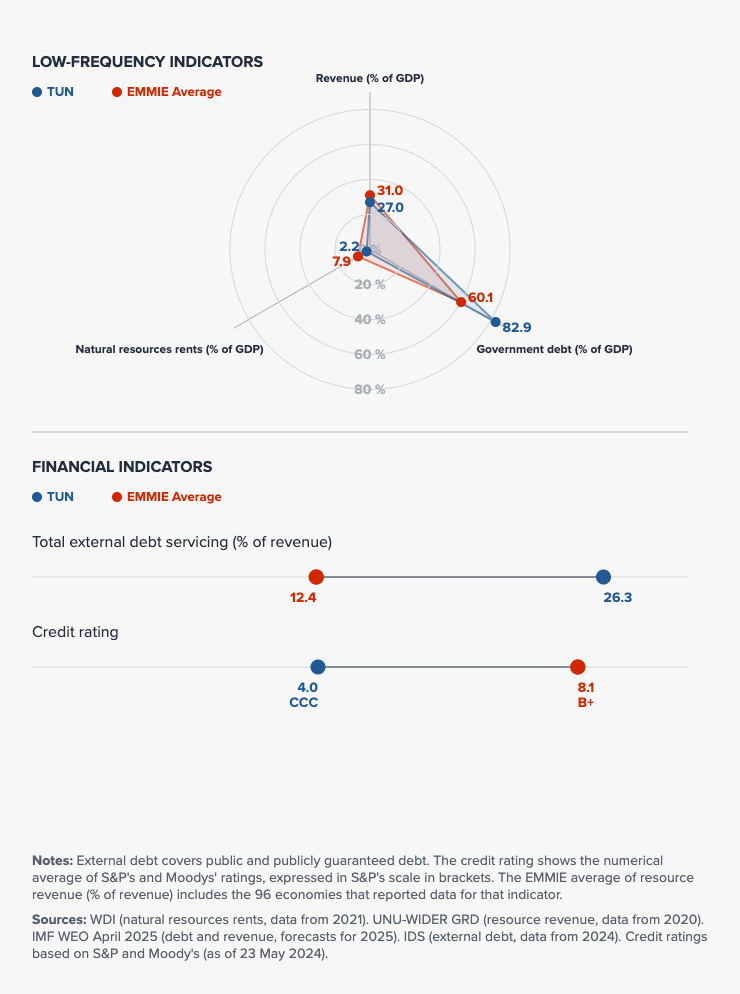
The radar diagram shows low frequency data points linked to government revenue and debt as a proportion of GDP as well as the natural resource share of total revenue. The financial indicator graphs show external debt servicing relative to revenue as well as the sovereign credit rating.

Tunisia's gross government debt is expected at 82.9% of GDP in 2025, which is 22.8 percentage points (pp) above the 60.1% for the group of emerging market and middle-income economies (EMMIE), and the country is battling a debt crisis since 2022. With revenue expected at 27% of GDP this year, Tunisia collects 4 percentage points (pp) less than the average EMMIE country with 31%. Natural resources account for 4.6% of the country’s revenue.

Tunisia’s external debt servicing this year is expected to be as high as 26.3% of revenue and thus double the EMMIE average of 12.3%. The country’s credit rating is in the ‘default’ category and the country has lost access to international financial markets, with issued bonds trading at deep discounts.

Tunisia is using an Integrated National Financing Framework to address key fiscal and financial constraints and build a more sustainable financial architecture at the national level. Priority reforms have been identified in the areas of tax policies, rationalization of public spending (including energy subsidies), foreign investments (including FDI) and private sector investments (including public-private partnerships), business environment, as well as the area of innovative financing, including green finance, sustainable bonds and impact monitoring and measurement.

Fiscal indicators visualization

Public Finance

Financing needs

NDC: Total: Estimated 19.3 billion USD total by 2030

  • 14.3 billion USD for mitigation
  • 4.3 billion USD for adaptation
  • 0.7 billion USD for capacity building actions

Financing strategy

Tunisia has sectoral action and investment plans for mitigation and adaptation investments under Stratégie Tunisie 2050 and the NDC. These plans will be updated as part of NDC 3.0 and the major objectives the government has committed to:

  • Reduce carbon intensity by 45% by 2030.
  • Achieve 30% renewable energy in electricity production by 2030.
  • Aim for carbon neutrality by 2050 as outlined in LT-LEDS.
  • Enhance governance and innovation for climate adaptation.
  • Integrate climate action into fiscal policies.
  • Strengthen climate resilience across sectors.
  • Promote sustainable and inclusive economic models.
  • Ensure sustainable development and efficient natural resource use.

Expenditures & budgets

Tunisia does not currently have a comprehensive system to track financial flows related to climate change support; however, ongoing discussions with the Ministry of Finance aim to integrate climate change into public policies and the state budget.

As part of the 2024 Biennial Transparency Report (BTR), partial tracking data show that Tunisia received around US$ 177 million for mitigation and adaptation—48% for mitigation, 43% for adaptation, and 9% for mixed activities. While the BTR monitors some financial flows for NDC implementation, no official centralised system exists. Collaboration with the Ministry of the Environment aims to enhance tracking and tracing of climate finance.

Debt instruments

  • The Conseil du Marché Financier published a guide to issuing green, socially responsible, and sustainable bonds in 2022.
  • The CDC to prepare a framework for issuing and monitoring green bonds and to identify a portfolio of sustainable green projects. Mitigation comes first with 53% of the amounts committed, followed by “Mixed” with 26% and Adaptation with 21%.​
  • 76% of the committed amounts are loans, and 24% are grants.
  • Tunisia is investing over US$ 15 million in climate resilience for its coastline through a debt-for-climate swap, supported by German funding.​

International climate finance

Over of US$1.867 billion for climate change efforts during 2021-2023 (investment financing, technology transfer, capacity building) including:

Private Finance & Economy

Policy & Regulatory Measures:

Innovative Instruments:

​Tunisia’s strategies and laws, such as the Green Economy Strategy, Startup Act, and Crowdfunding Law, foster SDG and climate financing by promoting innovation, green transitions, and sustainable investments, supported by financial regulations and incentives.

UIB, in collaboration with AFD, provides "Green Loans" to support energy efficiency and renewable energy projects, with funding of up to 2 million euros.

BNB Paribas, with AFD, offers the 15-million-euro SUNREF credit line to help Tunisian businesses invest in energy efficiency, waste recovery, and pollution reduction.

International Investment:

In 2022, FDI flows represented 1.5% of GDP.​ The Tunisia-Italy Electricity Integration project relies on PPPs for its completion and investment – up to US$ 147,1 million - and has received support from international donors like the World Bank.

Domestic Investment:

Private investment in companies, businesses, and housing has improved in recent years (except 2020), suggesting progress in Tunisia's business environment.

SDG Investor Map

SDG Investor Map Investment Opportunity Areas (IOAs) that contribute to the government's NDC priorities and meet SDG needs.

The priority IOAs span 11 Investment Opportunity Areas (IOAs) that contribute to the government’s NDC priorities and meet SDG needs. ​The priority IOAs span 4 climate-relevant sectors in Tunisia: climate-relevant sectors in Tunisia:

RENEWABLE RESOURCES AND ENERGY
INFRASTRUCTURE
FOOD AND AGRICULTUR
TECHNOLOGIES AND COMMUNICATION

Explore other NDC x SDG Insights