Hero image
Back to main site

Integrated
NDC X SDG Insights
Philippines


NDC x SDG Insights leverages data, AI, and systems analysis to identify
acceleration pathways and uncover systemic barriers to climate action,
positioning climate as a key driver of SDG achievement and informing the NDC 3.0 process.


Download as PDF

How To Read This Report

The NDC x SDG approach focuses on identifying the key interlinkages and pathways through which priority climate actions can accelerate a country’s most vital development goals. In doing so, it helps craft a clear, evidence-based narrative that brings together broad coalitions across government to drive coordinated progress.

The report is divided into four categories of analysis →

  • NDC x SDG Moment — human progress within planetary boundaries is the next development frontier. This section provides a snapshot of key climate and human development data.
  • NDC x SDG Alignment — maps climate commitments and national development priorities using custom machine learning tool that draws from an SDG vocabulary of 100k terms.
  • NDC x SDG Interlinkages — identifies national-level actions through enhanced NDCs that accelerate SDG achievement and advances a robust development case.
  • Finance & Stimulus — charts fiscal constraints and stimulus opportunities to ensure climate and development policy choices can be advanced with greatest impact.

1. NDC x SDG Moment

This section takes stock of the country’s current climate and sustainable development context, providing a clear snapshot of key climate and human development data and setting the scene to identify climate–development synergies.

As part of their mitigation policies and measures (PAMs), the Philippines has set a target of reducing emissions by

990 MtCO2e

(37%)
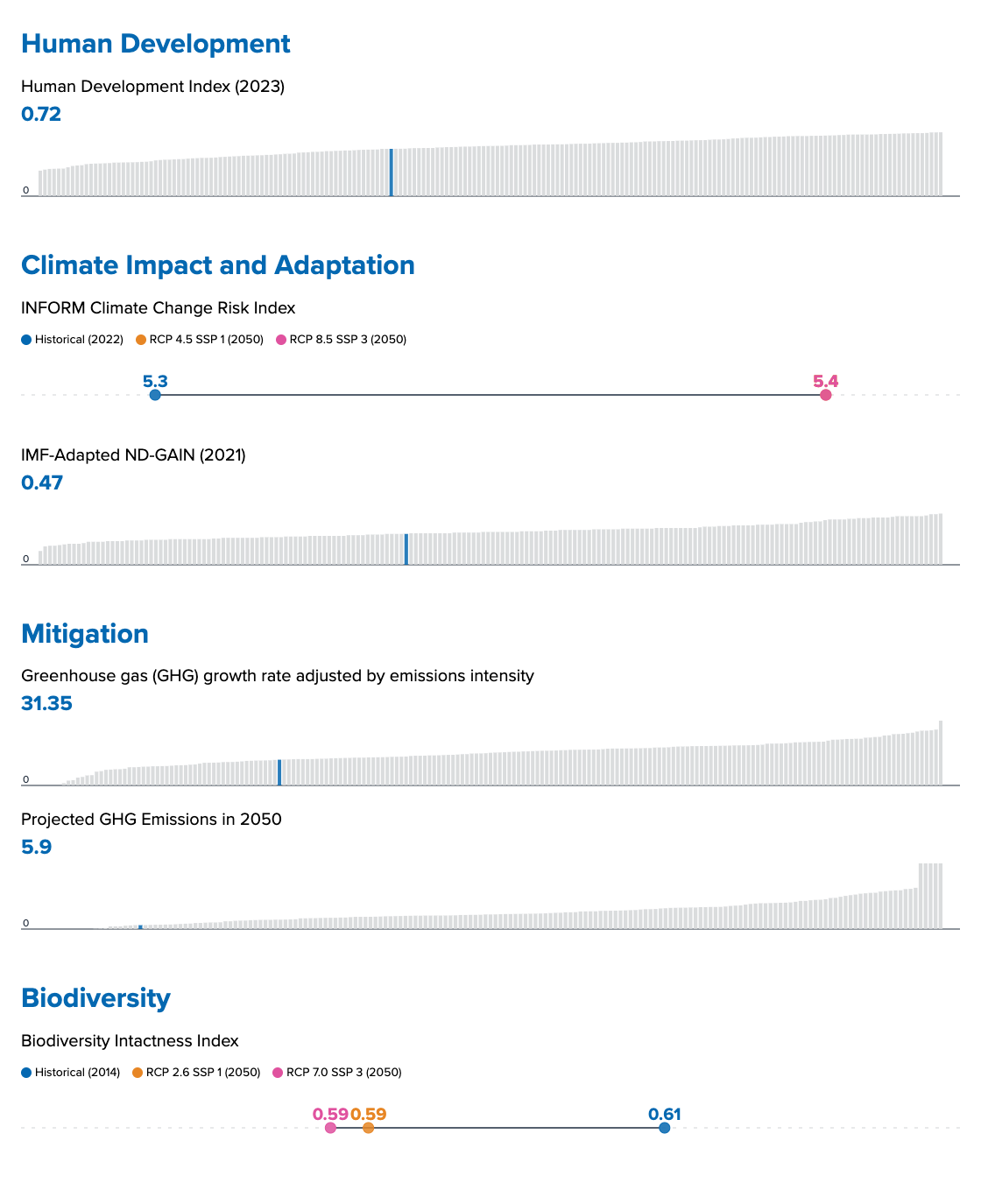
Human activities are the primary driver of climate change with severe environmental and socio-economic consequences. Integrating climate action for emissions reduction and enhanced resilience into development strategies can advance human development and provide multiple co-benefits.

The Philippines is in the high human development category (117th of 193) and the country’s IMF Adapted ND-GAIN index indicates continued vulnerability to climate disruptions and potential challenges to leveraging investments for adaptation actions.. Model-based projections indicate a score of 5.9/100 for projected emissions levels in 2050. The country’s projected Biodiversity Intactness Index similarly points to moderate impacts on biodiversity by 2050.

The Philippines’ existing Nationally Determined Contribution (NDC) commits to reducing greenhouse gas (GHG) emissions by 75% for the period 2020 to 2030. Implementation of the NDC is guided by a range of policies and measures across five key sectors: agriculture, waste, industry, transport, and energy. The NDC integrates both mitigation and adaptation actions, with cross-cutting priorities that include biodiversity, governance, just transition, and support for vulnerable populations.

The 2023–2028 Philippine Development Plan (PDP) focuses on job creation, poverty reduction, and resilient growth. Climate action is embedded throughout the plan, including through a dedicated chapter on accelerating climate action and strengthening disaster resilience. The PDP outlines strategies to build adaptive capacity, reduce disaster risks, enhance ecosystem resilience, and support a low-carbon development pathway as well as the importance of governance, data systems, and institutional capacity.

Philippines data visualization

Sources European Commission 2023 (INFORM Climate Change Risk Index), IMF 2022 (IMF-Adapted ND-GAIN Index); Environmental Performance Index 2024 (GHG growth rate adjusted by emissions intensity & Projected Emissions in 2050); Helen Phillips; Adriana De Palma; Ricardo E Gonzalez; Sara Contu et al. 2021 (Biodiversity Intactness Index).

NDC x SDG Alignment

Goal Level

This analysis shows the most prominent SDGs in each of the two national strategies on climate and development. This identifies areas of common action and potential synergies across national climate and development priorities.

Nationally Determined Contributon (NDC)

Note: Based on NDC (2021) and NDC Implementation Plan 2020-2030 (2023)

National Development Plan(s) (NDP)

Note: Based on Philippine Development Plan (2023-2028)

These visuals are generated by analyzing the NDCs and National Development Plans through the SDG framework at goal level.

NDC x SDG Alignment

Target Level

This analysis shows how the country’s climate actions, both mitigation and adaptation, align with and drive impact across the SDGs at the target level.

Mitigation NDCs

Adaptation NDCs

These visuals are generated by analyzing NDC actions through a custom-built AI tool and categorized using the SCAN tool to surface relevant SDG synergies at the Goal level. For additional information on the NDC-SDG mapping, please visit: https://ambitiontoaction.net/scan_tool/

NDC x SDG Alignment

Action Level

This section breaks down the NDC categories into specific country commitments identified through a custom-built AI tool. The bubble sizes show how many actions fall under each category, helping pinpoint where NDC–SDG acceleration is most likely.

Philippines 's NDC includes actions in these sectors:

Mitigation
Adaptation

3. NDC x SDG Interlinkages

NDC x SDG interlinkages reveal how climate actions can impact human development progress. Building from the country's NDC actions and SDG priorities, the following integrated SDG pathways reflect NDC actions with the most potential to accelerate the SDGs.

SDG 8.2

Diversify, innovate and upgrade for economic productivity

These two actions drive economic productivity (SDG 8.2) by diversifying the energy sector with advanced technologies. The large-scale push for renewables like offshore wind and emerging fields like green hydrogen can help create a new industrial sector, demanding a skilled workforce for manufacturing, installation, and maintenance. Incorporating nuclear power, particularly Small Modular Reactors (SMRs), can provide stable, baseload electricity. This reliability supports industrial output by securing energy supply and mitigating the cost of power interruptions. The strategic build-out of supporting infrastructure helps ensure a stable platform for economic growth.

Synergies with other SDG Targets:

SDG 3.9: Reducing emissions from fossil fuel power generation through the adoption of renewables and nuclear energy can help decrease the incidence of respiratory illnesses and premature deaths caused by air pollution.

SDG 9.2 & 9.5: The development of renewable and nuclear energy technologies promotes sustainable industrialization and fosters innovation. Building the requisite resilient infrastructure, such as upgraded ports and transmission grids, directly supports more advanced industrial capabilities.

SDG 11.2 & 11.3: Decarbonizing the power grid reduces urban air pollution, supporting sustainable transport systems and cleaner, more sustainable cities. A reliable, clean energy supply is fundamental to enhancing inclusive and sustainable urbanization.

Priority NDC Activities
Activity 1

Accelerated Renewable Energy Development

Activity 2

Deployment of Low-Carbon and Emerging Technologies in Transportation and Power Generation

NDC synergies with the priority SDGs
SDG 8.4

Improve resource efficiency in consumption and production

These two actions advance SDG 8.4 by decoupling personal and industrial transport (key for economic activity) from resource-intensive and polluting models. Planning integrated systems and promoting non-motorized transport shift mobility away from private vehicles, which are major consumers of fossil fuels, metals, and urban space. This transition improves resource efficiency by optimizing existing infrastructure (e.g., roads, hubs) for higher capacity use, reducing the need for new, resource-heavy construction. Lowering reliance on car-dependent mobility and imported fossil fuels can allow the economy to grow without a corresponding increase in environmental degradation from resource extraction and emissions.

Synergies with other SDG Targets:

SDG 3.9: Reducing vehicle emissions decreases illnesses and deaths from air pollution.

SDG 9.2 & 9.4: Fosters innovation in sustainable transport and improves resource efficiency.

SDG 10.2: Accessible NMT infrastructure promotes inclusion for marginalized groups.

SDG 11.3 & 11.4: Supports sustainable cities by reducing congestion and protecting cultural heritage from degradation.

Priority NDC Activities
Activity 1

Promoting non-motorized transport

Activity 2

Planning for integrated transport systems

NDC synergies with the priority SDGs
SDG 11.6

Reduce the environmental impacts of cities

The implementation of Energy Efficiency and Conservation (EEC) measures and the adoption of electric ferries are strategies that advance sustainable urban development, specifically SDG 11.6, by targeting air quality and energy waste. EEC reduces the energy demand from fossil fuel-powered electricity generation, the primary source of urban air pollution. Emissions of particulate matter and nitrogen oxides are curtailed by decarbonizing the energy system across industrial, commercial, and residential sectors, with resulting cleaner urban air. Furthermore, efficient technologies and practices minimize energy waste, indirectly reducing the waste streams associated with energy production. Concurrently, the shift to electric ferries on short-distance routes provides a direct, zero-tailpipe-emission mobility alternative, eliminating a source of local air and water pollution.

Synergies with other SDG Targets:

SDG 8.3 & 8.8: EEC drives productive activities and green entrepreneurship by creating jobs in auditing, retrofitting, and manufacturing. It also promotes safe and secure working environments by reducing pollution-related health risks for all workers.

SDG 9.2 & 9.5: The electric ferry initiative promotes sustainable industrialization and fosters innovation in green maritime technology and infrastructure.

SDG 14.1: Electric ferries prevent marine pollution by eliminating oil spills, reducing exhaust pollutants, and minimizing noise pollution in waterways, directly benefiting marine ecosystems.

Priority NDC Activities
Activity 1

Implementation of Energy Efficiency and Conservation (EEC) Measures

Activity 2

Developing low carbon ferry systems

NDC synergies with the priority SDGs

4. Finance & Stimulus

This section examines a country's fiscal space and public investment priorities, highlighting opportunities to align stimulus measures with SDG progress and accelerated climate action.

Many countries are facing reduced fiscal space, high debt levels, rising interest rates and downgrades on credit ratings. Fiscal and financial constraints tend to slow or even reverse SDG progress.
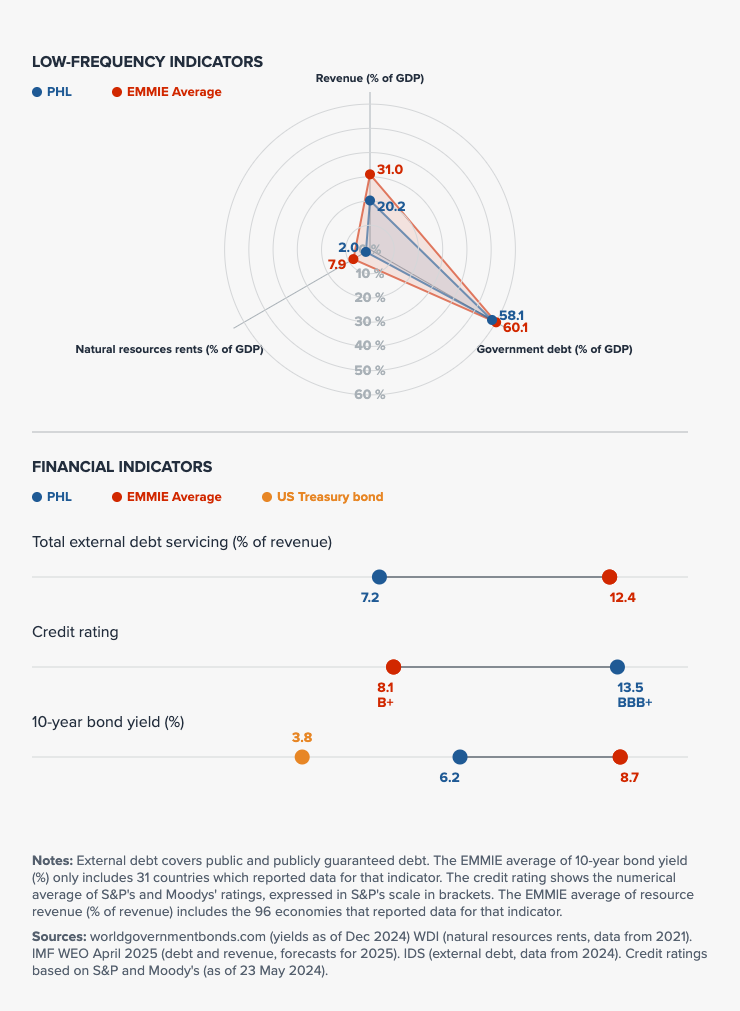
The radar diagram shows low frequency data points linked to government revenue, debt and natural resources rents as a proportion of GDP. The financial indicator graphs show external debt servicing relative to revenue and the country’s latest Debt Sustainability Assessment (DSA) risk rating.

The Philippine's gross government debt is expected at 62% of GDP in 2025, which is 210 percentage points (pp) above the middle-income countries average of 52.2%. The country is expected to collect 16% of GDP in revenue this year, thus 15 pp less than EMMIE average of 31%.

The Philippines’s external debt servicing this year is expected to reach 13.8% of revenue, which is 1.4 pp above the EMMIE average of 12.4%. The country’s credit rating is assessed as ‘investment grade’, and hence significantly above the EMMIE average of ‘highly speculative’.

Fiscal indicators visualization

Public Finance

Financing needs

  • Close fiscal gap from high debt and low revenue.
  • Fund climate resilience and infrastructure.
  • Mobilize private investment for green projects.

Financing strategy

  • Sovereign green bonds for international capital.
  • Policy incentives to attract private finance.
  • Dedicated funds like the People’s Survival Fund.

Expenditures & budgets

  • In 2025, Climate change expenditures totalling Php 1.020 trillion will support the strategic priorities of the National Climate Change Action Plan.
  • Similarly, the government is allocating Php 2.9 billion in 2025 to preserve Philippine forests through reforestation and sustainable management of protected areas.
  • The government is allocating Php 293 billion to strengthen disaster resilience through flood management infrastructure, disaster risk reduction, and rapid response funds.

Debt instruments

  • Sovereign Green Bonds: Issued under the Sustainable Finance Framework to raise international capital (e.g., ~USD 3.55 billion total, including bonds in the Japanese Samurai market).
  • Concessional Loans: Provided by government financial institutions for green projects, as mandated by laws like the Renewable Energy Act.

International climate finance

  • International resource mobilization based on the Sustainable Finance Framework
  • By October 2023, this framework has subsequently facilitated the successful execution of four sovereign transactions, mobilizing a total of approximately USD 3.55 billion in international capital. A significant component of this includes a JPY 70.1 billion (USD 550 million equivalent) bond issuance in the Japanese Samurai market.

Private Finance & Economy

Policy & Regulatory Measures:

Innovative Instruments:

  • Green bond issued in 2023 by Bank of the Philippine Island (BPI) to raise capital for financing green assets, with a USD 250 million buy-in by the IFC (IFC. 2023)
  • Third offering in 2025 of a sustainability bond by BDO Unibank , raising USD 947 million (Business World, 2024)
  • The Philippines has also participated in the issuance of a new sovereign catastrophe-linked bond (“CAT-bond”), arranged through the World Bank, which is structured to provide up to US$225 million in coverage over a three-year period (World Bank, 2020).

International Investment:

  • UAE's State energy firm Masdar carried out a USD 15 billion investment in 2025 to develop solar, wind and battery energy storage systems, providing it with up to 1 gigawatt of clean power by 2030. (Department of Energy, 2025).
  • Copenhagen Infrastructure Partners will invest USD 3 billion to build its first offshore wind farm in Camarines Sur. (PowerPhilippines.2025)

Domestic Investment:

  • BDO Unibank financing the world’s largest integrated solar and battery storage project, MTerra Solar (USD 2.5 billion) in Nueva Ecija. (BDO,2025)

SDG Investor Map

12 Investment Opportunity Areas (IOAs) that contribute to the government’s NDC priorities and meet SDG needs. The priority IOAs span 7 climate adaptation-relevant sectors in the Philippines:

RENEWABLE RESOURCES AND ENERGY
INFRASTRUCTURE
FOOD AND AGRICULTURE
HEALTHCARE
EDUCATION
FINANCE
TECHNOLOGY

Development Breakthrough
Policy Brief

Each NDC x SDG Insights policy brief is a focused, country-specific deep dive that builds on the broader Insights report to unpack a single development breakthrough, outlining its policy implications and the SDG-positive actions driving it forward.
Coming soon
Development Breakthrough Policy Brief

Explore other NDC x SDG Insights