Hero image
Back to main site

Integrated
NDC X SDG Insights
Bhutan


NDC x SDG Insights leverages data, AI, and systems analysis to identify
acceleration pathways and uncover systemic barriers to climate action,
positioning climate as a key driver of SDG achievement and informing the NDC 3.0 process.


Download as PDF

How To Read This Report

The NDC x SDG approach focuses on identifying the key interlinkages and pathways through which priority climate actions can accelerate a country’s most vital development goals. In doing so, it helps craft a clear, evidence-based narrative that brings together broad coalitions across government to drive coordinated progress.

The report is divided into four categories of analysis →

  • NDC x SDG Moment — human progress within planetary boundaries is the next development frontier. This section provides a snapshot of key climate and human development data.
  • NDC x SDG Alignment — maps climate commitments and national development priorities using custom machine learning tool that draws from an SDG vocabulary of 100k terms.
  • NDC x SDG Interlinkages — identifies national-level actions through enhanced NDCs that accelerate SDG achievement and advances a robust development case.
  • Finance & Stimulus — charts fiscal constraints and stimulus opportunities to ensure climate and development policy choices can be advanced with greatest impact.

1. NDC x SDG Moment

This section takes stock of the country’s current climate and sustainable development context, providing a clear snapshot of key climate and human development data and setting the scene to identify climate–development synergies.

As part of their mitigation measures, Bhutan has committed to remaining carbon neutral.

0 MtCO2e

(net)
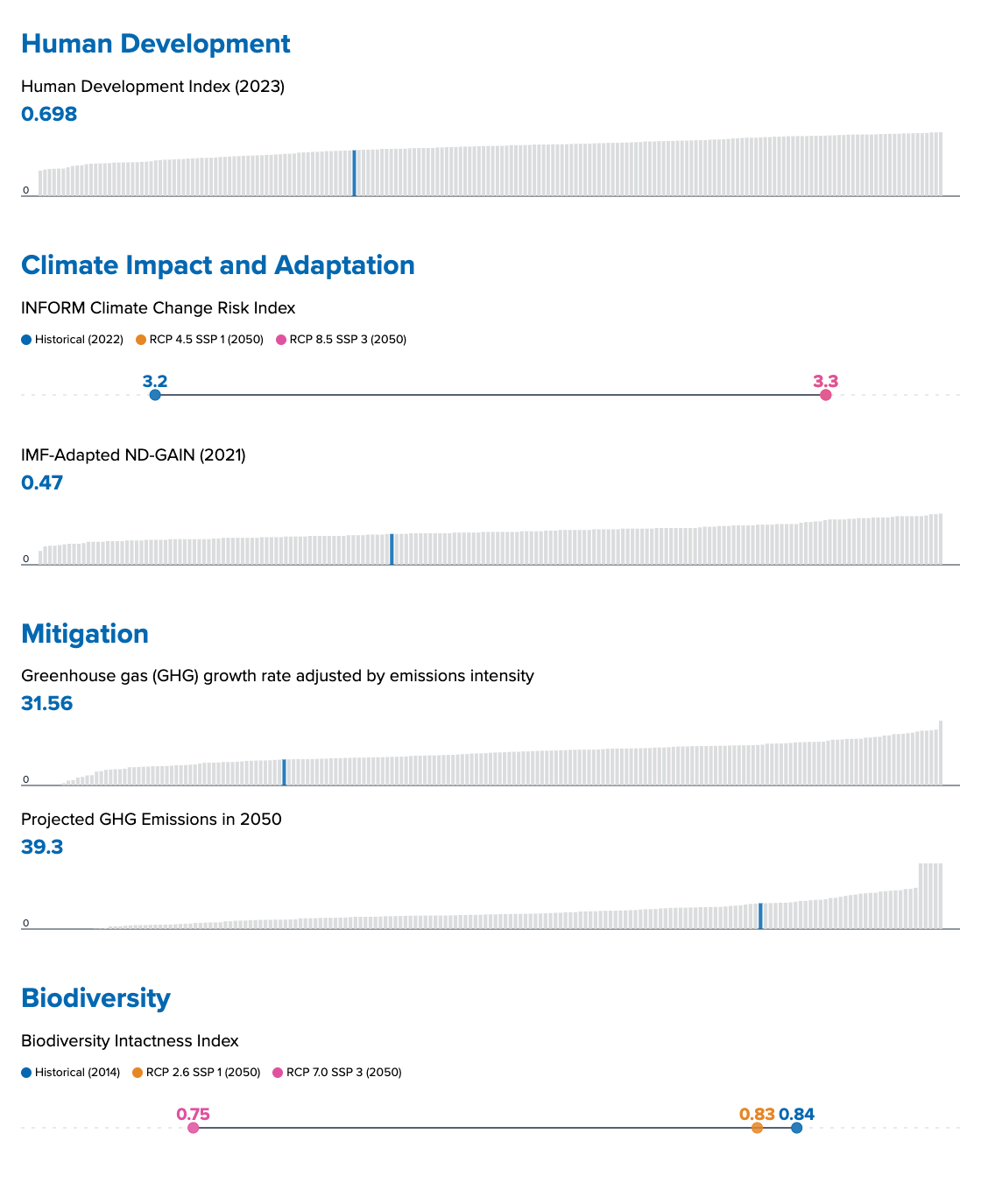
Human activities are causing significant climate change with severe environmental and socio-economic consequences. Integrating climate action for emissions reduction and enhanced resilience into development strategies can advance human development and provide multiple co-benefits.

Bhutan is in the medium human development category (125th of 193) and the country’s IMF Adapted ND-GAIN index indicates vulnerability to climate disruptions and challenges to leverage investments for adaptation actions. With a score of 39.3/100 for projected emissions levels in 2050, Bhutan is expected to face challenges in achieving carbon neutrality. Bhutan’s projected Biodiversity Intactness Index indicates a moderate impact on biodiversity in 2050.

The 13th Five-Year Plan (2024–2029) introduces an expanded agenda centered on economic diversification, foreign direct investment, green innovation, digitalization, and private sector revitalization, aligning broadly with many of the UN’s SDGs.

The Second NDC (2021) defines pathways across key sectors including sustainable forest management under the REDD+ framework, low-emission development for energy, transport, and industry, circular economy approaches for waste management, and broad-based electrification of heating and mobility leveraging Bhutan’s renewable power grid.

Bhutan data visualization

Sources European Commission 2023 (INFORM Climate Change Risk Index), IMF 2022 (IMF-Adapted ND-GAIN Index); Environmental Performance Index 2024 (GHG growth rate adjusted by emissions intensity & Projected Emissions in 2050); Helen Phillips; Adriana De Palma; Ricardo E Gonzalez; Sara Contu et al. 2021 (Biodiversity Intactness Index).

NDC x SDG Alignment

Goal Level

This analysis shows the most prominent SDGs in each of the two national strategies on climate and development. This identifies areas of common action and potential synergies across national climate and development priorities.

Nationally Determined Contributon (NDC)

Note: Based on Second Nationally Determined Contribution (2021)

National Development Plan(s) (NDP)

Note: Based on Thirteenth Five Year Plan (2024-2029) and Bhutan 21st century Economic Roadmap

These visuals are generated by analyzing the NDCs and National Development Plans through the SDG framework at goal level.

NDC x SDG Alignment

Target Level

This analysis shows how the country’s climate actions, both mitigation and adaptation, align with and drive impact across the SDGs at the target level.

Mitigation NDCs

Adaptation NDCs

These visuals are generated by analyzing NDC actions through a custom-built AI tool and categorized using the SCAN tool to surface relevant SDG synergies at the Goal level. For additional information on the NDC-SDG mapping, please visit: https://ambitiontoaction.net/scan_tool/

NDC x SDG Alignment

Action Level

This section breaks down the NDC categories into specific country commitments identified through a custom-built AI tool. The bubble sizes show how many actions fall under each category, helping pinpoint where NDC–SDG acceleration is most likely.

Bhutan 's NDC includes actions in these sectors:

Mitigation
Adaptation

3. NDC x SDG Interlinkages

NDC x SDG interlinkages reveal how climate actions can impact human development progress. Building from the country's NDC actions and SDG priorities, the following integrated SDG pathways reflect NDC actions with the most potential to accelerate the SDGs.

SDG 8.2

Diversify, innovate and upgrade for economic productivity

Proposed Activities 1 (alternative renewable energy program) and 2 (Sustainable Hydropower Policy) are designed to accelerate Bhutan’s progress on SDG Target 8.2 by diversifying its energy portfolio and upgrading its key economic sectors. Activity 1 expands the energy mix to include mini hydro, solar, wind, and waste-to-energy technologies, reducing reliance on large-scale hydropower while enabling high-value innovation in renewables. Activity 2 supports the long-term optimization of hydropower through reservoir and pumped storage schemes, alongside emerging technologies like hydrogen fuel and green ammonia, enhancing value-chain resilience and productivity. These efforts align with Bhutan’s 13th Five-Year Plan, the Climate Change Policy, and the MoEA’s push for green private-sector development under the “10X” GDP vision.

These activities also advance SDGs 3, 8, 9, 10, 11, and 16. Under SDG 3, Activity 1’s waste-to-energy technologies improve waste management and reduce indoor air pollution from traditional fuels, enhancing respiratory health in rural areas. For SDG 8, the expansion of diverse green energy sectors—such as solar, wind, and hydrogen—creates skilled jobs beyond construction-phase hydropower, supporting economic inclusion and aligning with MoLHR’s labor productivity and youth employment agenda. Regarding SDG 9, both activities promote infrastructure modernization and clean innovation, enabling energy-intensive industries like data centers and supporting Bhutan’s low-emission industrial transition. For SDG 10, greater access to clean, locally generated energy reduces health burdens and time poverty, particularly for rural women, advancing equitable development. Under SDG 11, the transition to clean energy and electric mobility improves urban air quality, resource efficiency, and climate resilience, exemplified by sustainable urban development efforts like the Gelephu Mindfulness City. Lastly, SDG 16 is reinforced through inclusive, transparent governance tools—such as the GNH Policy Screening Tool and Strategic Environmental Assessments (SEAs)—alongside institutional capacity-building supported by the World Bank CPF.

Priority NDC Activities
Activity 1

An alternative renewable energy program consisting of mini hydro, solar, wind and waste-to-energy technologies will be pursued as a priority program with the aim to reduce deforestation in rural communities and diversify the energy portfolio as adaptation measure to changing water flows, particularly in the dry seasons.

Activity 2

Future development of hydropower will be as per the revised Sustainable Hydropower Policy 2021 and enhances climate resilience through reservoir/pumped storage schemes to ensure energy and water security.

NDC synergies with the priority SDGs
SDG 8.4

Improve resource efficiency in consumption and production

Proposed Activities 1 (domestic biogas production), 2 (electrification of cooking and heating), and 3 (mass transit systems) directly support Bhutan’s ambition under the principles of GNH to decouple economic growth from environmental degradation, by improving resource efficiency across livestock, human settlements, and transport. Activity 1 promotes small-scale biogas units that convert animal waste into energy and fertilizer, supporting circular economy models and reducing deforestation and fertilizer dependency. Activity 2 leverages Bhutan’s nearly 100% hydropower grid to replace LPG and firewood with clean electricity in households, cutting GHG emissions and reducing reliance on imported fossil fuels. Activity 3 improves urban mobility through expanded bus systems and light rail, decreasing fuel consumption and supporting low-emission transport aligned with the country’s LED strategies. These efforts advance Bhutan’s carbon-neutrality commitment and align with the Climate Change Policy, National Energy Efficiency and Conservation Policy (2019), and SDG7 Roadmap.

These activities also generate co-benefits for SDGs 3, 8, 9, 10, 11, and 16. Under SDG 3, reduced indoor air pollution from clean cooking and heating technologies improves respiratory health, especially for women. For SDG 8, these shifts support rural livelihoods, increase labor productivity, and improve access to economic opportunities via mass transit. For SDG 9, biogas and EV infrastructure strengthen decentralized energy systems and promote clean technology adoption. Under SDG 10, these interventions reduce spatial and gender disparities by improving access to energy and transport in underserved areas. Activity 1 also enhances urban and rural sustainability by improving organic waste management and reducing emissions from the agriculture and livestock sector, supporting SDG 11 through cleaner, more efficient resource use in human settlements. Finally, for SDG 16, implementation is grounded in Bhutan’s whole-of-government coordination, participatory policy tools like SEAs, and institutional reforms outlined in the “10X” roadmap and supported by the World Bank CPF.

Priority NDC Activities
Activity 1

Low Emission Development Strategy for Food security: Small and medium scale domestic biogas production

Activity 2

Low Emission Development Strategy for Human Settlement: Replacement of LPG and firewood by electricity,

Activity 3

Mass transit though improvements in bus systems and the introduction of open-bus rapid transit (BRT) network (electric and diesel) and light rail transit.

NDC synergies with the priority SDGs
SDG 9.4

Upgrade all industries and infrastructures for sustainability

Proposed Activities 1 (efficient street lighting), 2 (energy-efficient and green building design), and 3 (renewable charcoal and cement blending) directly advance SDG 9.4 by promoting sustainable infrastructure upgrades, industrial retrofitting, and increased resource-use efficiency. Activities 1 and 2, under the LEDS for Human Settlement, focus on upgrading municipal services and buildings through energy-efficient lighting and sustainable construction standards. These measures reduce electricity demand and introduce cleaner technologies aligned with Bhutan’s National Energy Efficiency & Conservation Policy (2019) and voluntary Bhutan Green Building Guidelines. Activity 3, from the LEDS for Industries, targets major industrial emissions sources by replacing fossil reductants with renewable charcoal in ferroalloy production and using blended cement to reduce clinker content—modernizing industrial processes and reducing GHG emissions. These actions reflect Bhutan’s policy commitment to low-emission development and sustainable industrial transformation, as set out in the 13th Five-Year Plan and the “10X” vision.

Together, these activities contribute to SDGs 3, 8, 9, 10, 11, and 16. For SDG 3, cleaner energy use and reduced industrial emissions improve both outdoor and indoor air quality, supporting respiratory health and broader public well-being. Under SDG 8, investments in green building, efficient lighting, and low-emission manufacturing spur job creation and technological upskilling across construction, design, and industrial sectors. For SDG 9, the adoption of renewable charcoal, cement blending, and energy-efficient infrastructure catalyses innovation in materials and industrial processes, aligning with Bhutan’s transition to a low-carbon economy. Under SDG 10, access to clean infrastructure and reduced exposure to pollution foster more equitable environments, particularly for vulnerable populations living near urban or industrial zones. For SDG 11, sustainable lighting and green building practices directly enhance the liveability, energy efficiency, and resilience of Bhutan’s cities and human settlements. Finally, under SDG 16, successful implementation depends on effective coordination, participatory governance, and institutional capacity—principles embedded in Bhutan’s Climate Change Policy and operationalized through cross-sectoral mechanisms like the LEDS and Five-Year Plans.

Priority NDC Activities
Activity 1

Low Emission Development Strategy for Human Settlement: Efficient street lighting,

Activity 2

Low Emission Development Strategy for Human Settlement: Energy efficient and green building design,

Activity 3

Low Emission Development Strategy for Industries (manufactures): Replacing fossil origin reductants with renewable charcoal, and Cement blending

NDC synergies with the priority SDGs

4. Finance & Stimulus

This section examines a country's fiscal space and public investment priorities, highlighting opportunities to align stimulus measures with SDG progress and accelerated climate action.

Many countries are facing reduced fiscal space, high debt levels, rising interest rates and downgrades on credit ratings. Fiscal and financial constraints tend to slow or even reverse SDG progress.
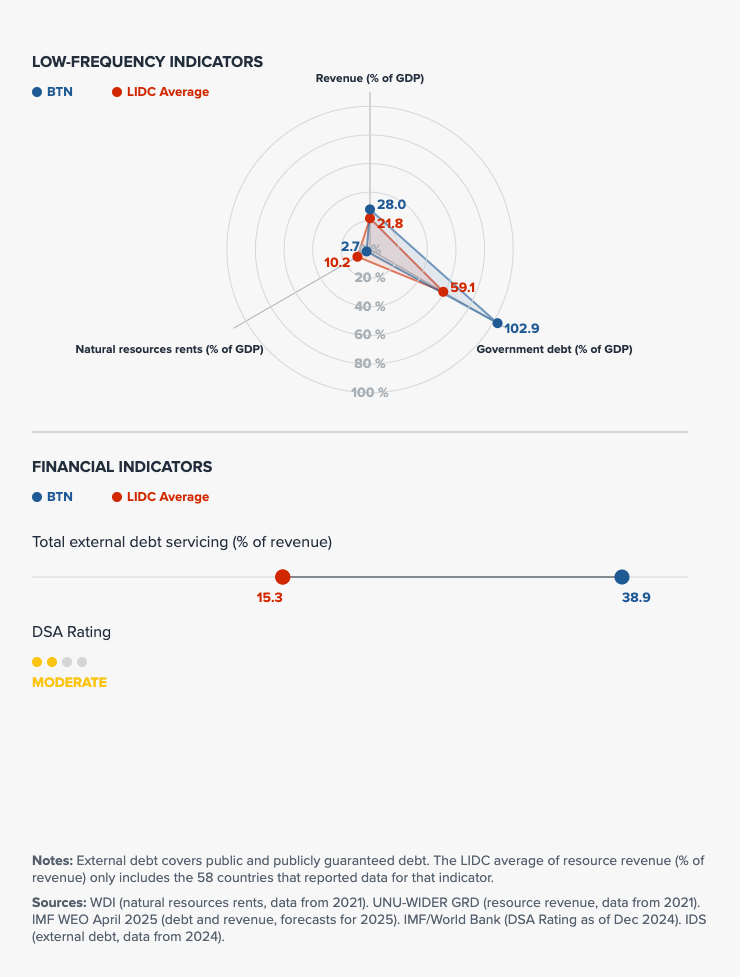
The radar diagram shows low frequency data points linked to government revenue, debt and natural resources rents as a proportion of GDP. The financial indicator graphs show external debt servicing relative to revenue and the country’s latest Debt Sustainability Assessment (DSA) risk rating.

Bhutan's gross government debt is expected at 102.9% of GDP in 2025, which is 43.8 percentage points (pp) above the low-income developing countries (LIDC) average of 59.1%. The country is expected to collect 28% of GDP in revenue this year, or 6.2 percentage points (pp) above the LIDC average of 21.8%.

Bhutan’s external debt servicing this year is expected to reach 38.9% of revenue, which is 23.6 pp above the LIDC average of 15.3%.

Fiscal indicators visualization

Public Finance

Financing needs

SDGs: Over 15 million USD per annum in capital investment required to reach growth targets necessary for chieving SDGs (DFA 2021)

NDC:

  • 0.38 billion USD for mitigation in the short term
  • 0.6 billion USD for adaptation in the short term
  • An additional USD 6,4 billion in the longer term

Financing strategy

10-year strategic plan of the Royal Monetary Authority, named Druk Nguldrel Lamtoen-2030

  • 3rd Pillar of the Strategy: 'Advancing Green Finance for a Sustainable and Green Economy', with two core objectives:
  • I) Create an enabling regulatory environment to nurture financing for a green economy.
    (ii) Develop the capital market and innovative financial instruments to promote investment in green projects and businesses

Expenditures & budgets

  • USD 244 million allocated for 2024/25 across governmental agencies to implement climate change adaptation and mitigation activities (Ministry of Finance, 2024).
  • Close to USD 14 billion needed to finance climate adaptation measures identified under the National Adaptation Plan (NAP) between 2023 and 2038.

Debt instruments

  • World Bank provided in 2024 US $40 million for a 'Climate and Disaster Resilience Development Policy Financing (DPF) with a Catastrophe Deferred Drawdown Option (Cat DDO)'.
  • World Bank provided in 2023 USD 30 million in the frame of the 'Second Green and Resilient Growth Development Policy Credit' to foster green growth focused on renewable natural resources.

International climate finance

  • USD 356 million (approx.) provided by GEF across 26 projects. (GEF, 2025)
  • For example: USD 20 million from the GEF-LDCF in 2025 for 'Enhancing Climate Resilience of Urban Landscapes and Communities in Thimphu-Paro Region' (GEF, 2025).
  • USD 68.84 million provided by GCF as of 2024, with 4 active projects and 7 readiness activities (GCF, 2024)

Private Finance & Economy

Policy & Regulatory Measures:

Innovative Instruments:

  • Government issued its first sovereign bond in 2020 for USD 41 million to meet fiscal financing requirements in the frame of the COVID-19 pandemic (ESCAP, 2020)

International Investment:

  • Mirova and Finnfund carried out in 2025 a USD 7.9 million equity investment in the agri-enterprise Mountain Hazelnuts, to carry out an expansion of processing facilities and a climate adaptation grafting programme (Business Bhutan, 2025). Adani Power signed in 2025 a shareholder agreement with Druk Green Power Corp (DGPC) for a USD 673 million investment in the Wangchhu (or Wangchu) Hydroelectric Project (Adani Power, 2025).
  • Adani Power signed in 2025 a shareholder agreement with Druk Green Power Corp (DGPC) for a USD 673 million investment in the Wangchhu (or Wangchu) Hydroelectric Project, (Adani Power, 2025)

Domestic Investment:

  • The State-owned Power Finance Corporation provided in 2025 a loan of USD 582 million to Tata Power and DGPC for the Khorlochhu Hydropower Project

Development Breakthrough
Policy Brief

Each NDC x SDG Insights policy brief is a focused, country-specific deep dive that builds on the broader Insights report to unpack a single development breakthrough, outlining its policy implications and the SDG-positive actions driving it forward.
Coming soon
Development Breakthrough Policy Brief

Explore other NDC x SDG Insights