SDG Push Insight report
Dominican Republic
Hero image
Back to main site

Integrated
NDC X SDG Insights
Dominican Republic


NDC x SDG Insights leverages data, AI, and systems analysis to identify
acceleration pathways and uncover systemic barriers to climate action,
positioning climate as a key driver of SDG achievement and informing the NDC 3.0 process.


Download as PDF

How To Read This Report

The NDC x SDG approach focuses on identifying the key interlinkages and pathways through which priority climate actions can accelerate a country’s most vital development goals. In doing so, it helps craft a clear, evidence-based narrative that brings together broad coalitions across government to drive coordinated progress.

The report is divided into four categories of analysis →

  • NDC x SDG Moment — human progress within planetary boundaries is the next development frontier. This section provides a snapshot of key climate and human development data.
  • NDC x SDG Alignment — maps climate commitments and national development priorities using custom machine learning tool that draws from an SDG vocabulary of 100k terms.
  • NDC x SDG Interlinkages — identifies national-level actions through enhanced NDCs that accelerate SDG achievement and advances a robust development case.
  • Finance & Stimulus — charts fiscal constraints and stimulus opportunities to ensure climate and development policy choices can be advanced with greatest impact.

1. NDC x SDG Moment

This section takes stock of the country’s current climate and sustainable development context, providing a clear snapshot of key climate and human development data and setting the scene to identify climate–development synergies.

As part of their NDC the Dominican Republic has set a target of reducing emissions by

13.85 MtCO2e

(27%)
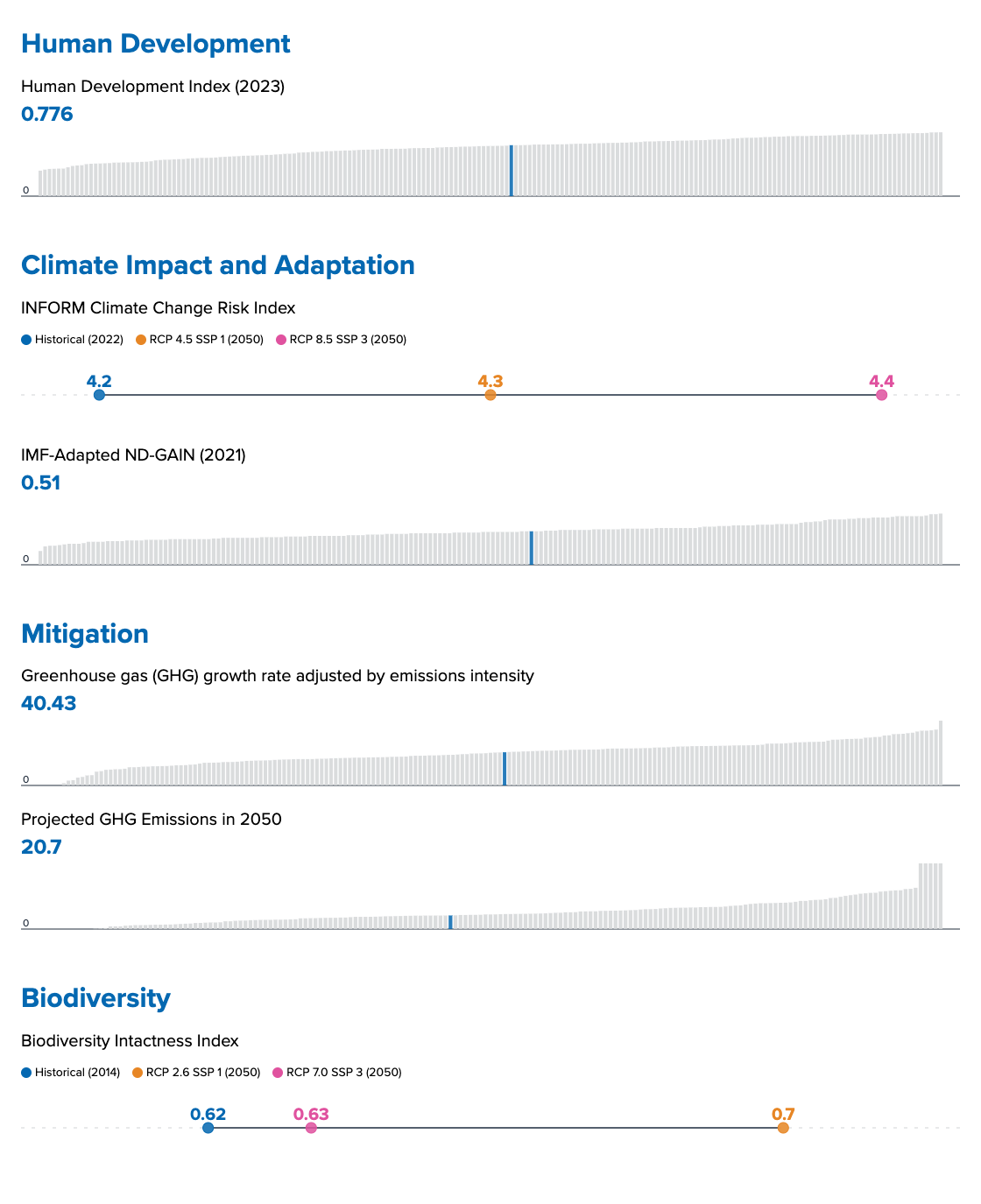
Human activities are causing significant climate change with severe environmental and socio-economic consequences. Integrating climate action for emissions reduction and enhanced resilience into development strategies can advance human development and provide multiple co-benefits.

All countries are navigating through a period of profound global uncertainty and shrinking development space that is affecting the landscape of global growth. The vulnerability of debt is at its highest level in decades in many developing economies, coinciding with a period when donors are making substantial cuts to aid flows. With these global challenges, it’s important to leverage finance and resources nationally to drive development priorities.

The Dominican Republic is in the high human development category (89th of 193) and the country’s IMF Adapted ND-GAIN index indicates vulnerability to climate disruptions and challenges in leveraging investments for adaptation actions. With a score of 20.7/100 for projected emissions levels in 2050, the Dominican Republic is expected to face challenges in achieving carbon neutrality. the Dominican Republic’s projected Biodiversity Intactness Index indicates moderate impact on biodiversity in 2050.

The Dominican Republic’s development aspirations aim to transform the country into a high-income, resilient, and inclusive economy. By 2036, the nation seeks to double real GDP, reduce poverty below 10%, expand the middle class, raise educational attainment, and increase life expectancy, while strengthening institutions, productivity, and sustainability.

The Dominican Republic’s 2020 NDC raises its climate ambition by committing to a 27% reduction in emissions by 2030, with both conditional and unconditional targets supported by 46 mitigation measures. It also incorporates 37 adaptation actions, emphasizing water, food, and urban resilience, with investments of nearly USD 17.6 billion, and transversal principles of inclusion, equity, youth, and human rights, aligned with the 2030 SDGs.

Dominican Republic data visualization

Sources European Commission 2023 (INFORM Climate Change Risk Index), IMF 2022 (IMF-Adapted ND-GAIN Index); Environmental Performance Index 2024 (GHG growth rate adjusted by emissions intensity & Projected Emissions in 2050); Helen Phillips; Adriana De Palma; Ricardo E Gonzalez; Sara Contu et al. 2021 (Biodiversity Intactness Index).

NDC x SDG Alignment

Goal Level

This analysis shows the most prominent SDGs in each of the two national strategies on climate and development. This identifies areas of common action and potential synergies across national climate and development priorities.

Nationally Determined Contributon (NDC)

Note: Based on Updated Nationally Determined Contribution (2020)

National Development Plan(s) (NDP)

Note: Based on Pluriannual National Plan of the Public Sector

These visuals are generated by analyzing the NDCs and National Development Plans through the SDG framework at goal level.

NDC x SDG Alignment

Target Level

This analysis shows how the country’s climate actions, both mitigation and adaptation, align with and drive impact across the SDGs at the target level.

Mitigation NDCs

Adaptation NDCs

These visuals are generated by analyzing NDC actions through a custom-built AI tool and categorized using the SCAN tool to surface relevant SDG synergies at the Goal level. For additional information on the NDC-SDG mapping, please visit: https://ambitiontoaction.net/scan_tool/

NDC x SDG Alignment

Action Level

This section breaks down the NDC categories into specific country commitments identified through a custom-built AI tool. The bubble sizes show how many actions fall under each category, helping pinpoint where NDC–SDG acceleration is most likely.

Dominican Republic 's NDC includes actions in these sectors:

Mitigation
Adaptation

3. NDC x SDG Interlinkages

NDC x SDG interlinkages reveal how climate actions can impact human development progress. Building from the country's NDC actions and SDG priorities, the following integrated SDG pathways reflect NDC actions with the most potential to accelerate the SDGs.

SDG 7.3

Double the rate of improvement in energy efficiency

These three climate actions from the Dominican Republic’s NDC 2020 directly advance SDG target 7.3 by promoting energy efficiency across sectors. The air conditioning replacement program applies Minimum Energy Performance Standards to 689,389 units, significantly lowering electricity use. Green building codes in new constructions cut energy demand by 10% annually, while high-efficiency electric motors in industry further reduce consumption and emissions, strengthening the country’s sustainable growth agenda consistent with long-term national strategies like Meta RD 2036.

These energy efficiency actions can accelerate three additional SDG targets. SDG 11.6 (reduce environmental impact of cities) benefits from reduced urban energy consumption and emissions through efficient buildings and appliances. SDG 13.2 (integrate climate measures into policies) is advanced through concrete mitigation actions reducing 4,481.13 Gg CO2eq combined. SDG 9.4 (upgrade infrastructure for sustainability) is supported by establishing green building standards, creating more sustainable and resilient urban systems.

SDG 7.3 creates significant cross-sectoral impacts on multiple development targets. It accelerates SDG 8.5 (decent work and economic growth) by generating employment in green technology sectors and reducing energy costs for businesses. SDG 16.6 (effective institutions) benefits from enhanced regulatory frameworks and monitoring systems for energy efficiency standards. SDG 11.6 (sustainable cities) is advanced through reduced urban environmental impact via lower energy consumption, decreased emissions, and improved air quality from efficient buildings and infrastructure systems.

Priority NDC Activities
Activity 1

New standards for the acquisition of industrial electric motors.

Activity 2

Energy Efficiency Standards in New Constructions

Activity 3

Air Conditioning Replacement Program with More Efficient Standards

NDC synergies with the priority SDGs
SDG 8.4

Improve resource efficiency in consumption and production

Converting fuel oil power plants to natural gas has the largest structural impact, improving efficiency, lowering system costs, and cutting the national carbon footprint. In cement production, replacing pet coke with biomass decouples output from fossil fuels, boosting eco-efficiency. Further reducing clinker content decreases energy use and raw material demand. Together, these actions enable sustained economic growth while sharply reducing environmental degradation, directly advancing SDG target 8.4 on resource efficiency and decoupling economic growth from environmental degradation.

The implementation of these three industrial actions could generate benefits that go beyond SDG target 8.4. The conversion to natural gas and the use of biomass (SDG target 7.2) reduce air pollution, improving health and well-being (SDG target 3.9) and makes cities more sustainable (SDG target 11.6). The reduction of clinker and the valorization of waste could foster industrial innovation (SDG target 9.4) as well as promote responsible consumption and production patterns (SDG targets 12.2 and 12.5), directly contributing to climate action (SDG target 13.2).

SDG Target 8.4 connects also with Target 16.6 by requiring effective institutions that ensure transparent resource efficiency policies; with Target 10.1 by promoting more sustainable and inclusive economic growth that reduces inequalities; and with Target 11.6 by decreasing pollution and waste, thereby improving urban sustainability.

Priority NDC Activities
Activity 1

Conversion fuel oil power generation units in the electricity system to lower-GWP natural gas.

Activity 2

Use of alternative fuels (including biomass) as a substitute for conventional fossil fuels (coal/pet coke, etc.)

Activity 3

Further reduction of clinker content in Dominican cement.

NDC synergies with the priority SDGs
SDG 11.5

Reduce the adverse effects of natural disasters

Early warning systems, resilient urban planning, and strong building codes reduce disaster mortality and economic losses, enhancing national resilience. These actions advance SDG 11.5 and the NDC’s adaptation goals, while supporting Meta RD 2036 by safeguarding infrastructure, human capital, and productivity. This creates a feedback loop: NDC measures strengthen SDG achievement, and together they reinforce the long-term, inclusive, and sustainable growth path required to double GDP by 2036.

These three actions also advance SDG 1, 3, and 16. By reducing disaster-related losses, they protect livelihoods and assets, preventing people from falling into poverty (SDG 1). Strengthened infrastructure and early warnings reduce injuries, disease, and deaths from extreme events, improving public health and well-being (SDG 3). Moreover, effective planning, building regulation, and risk management enhance institutional capacity and accountability, fostering trust and stronger governance systems (SDG 16). Together, they promote resilience, safety, and inclusive sustainable development.

SDG 11.5 is closely linked to SDG targets 13.1, 6.2, and 7.1. Strengthening resilience to disasters (11.5) directly supports climate adaptation and risk reduction (13.1). Improved water and sanitation systems (6.2) are essential for protecting communities from flood-related contamination. Expanding access to reliable and clean energy (7.1) enables early warning systems and resilient infrastructure. Together, these targets reinforce community safety, reduce vulnerabilities, and promote sustainable urban and climate-resilient development.

Priority NDC Activities
Activity 1

Improve urban planning and land use to promote climate resilience.

Activity 2

Improve building codes to integrate climate risk.

Activity 3

Enhance the early warning system for hydro-meteorological events.

NDC synergies with the priority SDGs
SDG 16.6

Develop effective, accountable and transparent institutions

The creation of a body of independent experts to formally evaluate the objectives, strategies, and progress of climate policy is a key step toward building more accountable and transparent institutions. By subjecting government decisions to external scrutiny, it ensures impartial oversight that strengthens accountability and limits discretion in public management. This mechanism not only reinforces citizens’ trust but also promotes stronger climate governance. Ultimately, it fosters a system that is more inclusive, resilient, and aligned with international standards of transparency, integrity, and responsibility.

In addition to SDG 16, these climate governance actions significantly strengthen other Sustainable Development Goals. The creation of citizen consultation and participation mechanisms directly boosts SDG 5 (Gender Equality) by ensuring the inclusion of women in decision-making. Likewise, it promotes SDG 17 (Partnerships for the Goals) as it encourages collaboration between the government, the private sector, and civil society. Finally, by improving the planning and transparency of climate policies, it positively impacts SDG 13 (Climate Action).

Investing in a more effective governance and improving resource allocation efficiency (target 16.6) , will support the achievement of target 8.1 on sustained economic growth, as stable institutions create an environment for investment and productivity. Transparent and fair institutions also advance target 10.1 by reducing inequality through equitable policies. Furthermore, accountable governance enhances target 3.8 by enabling universal access to essential health services.

Priority NDC Activities
Activity 1

Creation of an independent expert advisory and evaluation mechanism

Activity 2

Establishment of a citizen consultation council on climate change

Activity 3

Development of a National Strategy for Action for Climate Empowerment

NDC synergies with the priority SDGs

4. Finance & Stimulus

This section examines a country's fiscal space and public investment priorities, highlighting opportunities to align stimulus measures with SDG progress and accelerated climate action.

Many countries are facing reduced fiscal space, high debt levels, rising interest rates and downgrades on credit ratings. Fiscal and financial constraints tend to slow or even reverse SDG progress.
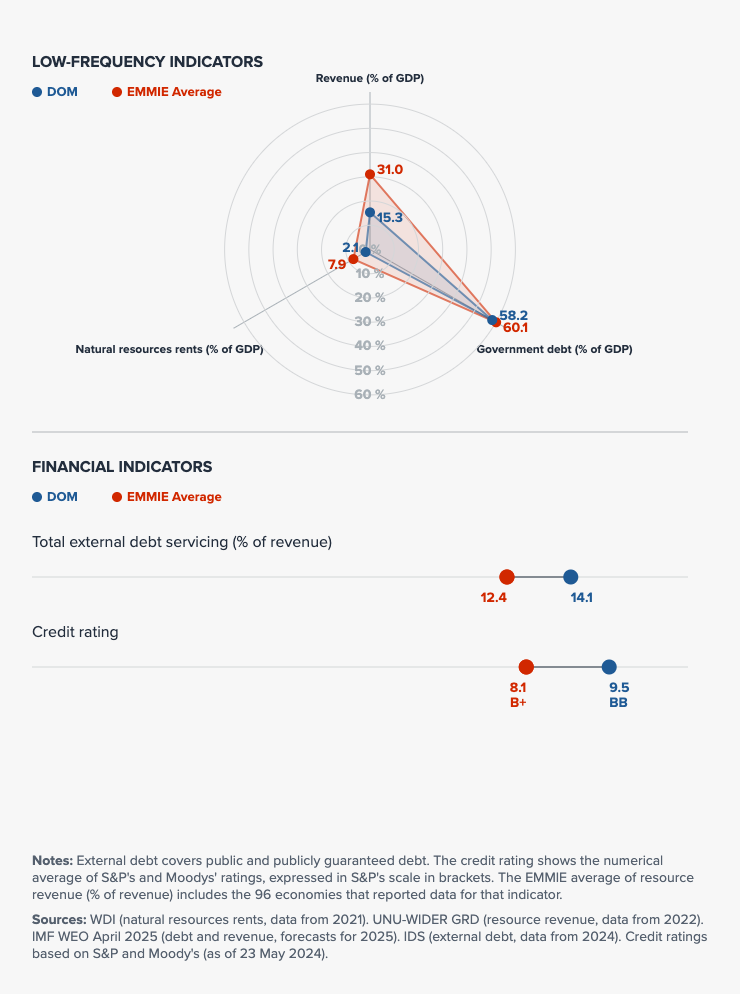
The radar diagram shows low frequency data points linked to government revenue, debt and natural resources rents as a proportion of GDP. The financial indicator graphs show external debt servicing relative to revenue and the country’s latest Debt Sustainability Assessment (DSA) risk rating.

The Dominican Republic's gross government debt is expected at 58.2% of GDP in 2025, which is 1.9 percentage points (pp) below the emerging market and middle-income economies’ (EMMIE) average of 60.1%. The country is expected to collect 15.3% of GDP in revenue this year, thus about half of the EMMIE average of 31%.

The Dominican Republic’s external debt servicing this year is expected to reach 14.1% of revenue, which is 1.7 pp below the EMMIE average of 12.4%. The country’s credit rating is in the ‘speculative’ category, above the EMMIE ‘highly speculative’ average.

According to the IMF, Dominican Republic’s economy grew around 5% in 2024, but spending pushed up fiscal deficits and debt. The World Bank highlights fiscal pressures: revenue mobilization is only 16.3% of GDP, debt is above pre pandemic levels, and energy losses and interest payments (1.2% and 3.4% of GDP) restrict investment. A fiscal responsibility law caps primary expenditure growth and aims to reduce debt to 40% by 2035.

Fiscal indicators visualization

Public Finance

Financing needs

SDGs: Over 6,900 million USD per annum in capital investment required for achieving SDGs (IMF)

NDC: Total: Estimated 20.45 billion USD total by 2030

  • 10.34 billion USD for mitigation
  • 10.11 billion USD for adaptation

Financing strategy

The Dominican Republic is advancing in mobilizing financial resources to meet its climate and sustainable development commitments. Since 2021, it has been reviewing its planning and budget management to strengthen investment decisions, monitoring, and spending efficiency. The country is designing a National Climate Finance Strategy that promotes green financing instruments, long-term public-private cooperation, and enhanced engagement with the Green Climate Fund, with estimated investments exceeding USD 20.45 billion in mitigation and adaptation for 2021–2030.

Expenditures & budgets

The Dominican Republic’s public budgeting system aligns with the SDGs through its linkage to the National Planning and Public Investment System. The 2024–2027 Multiannual Budget Framework prioritizes key sectors like health, education, environment, and social protection, assigning and protecting budgets annually. However, SDG alignment could improve through systematic budget tagging and stronger programmatic integration.

Debt instruments

The Dominican Republic issued its first sovereign green bond on June 25, 2024, in the international market for USD 750 million, with a 12-year maturity and a coupon of approximately 6.6 percent. It also adopted a Green, Social, and Sustainability Bond Framework in June 2024, defining eligible sectors such as clean transport, renewable energy, waste management, water, health, and education.

International climate finance

The Dominican Republic has received international climate finance from the Green Climate Fund through projects such as FP174 with USD 174.3 million, FP242, and FP237; the Adaptation Fund with approximately USD 10 million; and the Global Environment Facility with USD 12.6 million in grants via the Small Grants Programme. It also benefits from Euroclima technical assistance and an endorsed USD 85 million Climate Investment Funds plan.

Private Finance & Economy

Policy & Regulatory Measures:

Innovative Instruments:

A total of thirteen innovative financial instruments were identified and assessed to support the financing of the National Development Strategy and the prioritized Sustainable Development Goals. Among them are thematic bonds, including green, social, sustainable, and sustainability-linked bonds, debt-for-nature swaps, diaspora financing through various forms of remittances and equity participation, payments for environmental services, Public-Private Partnerships for sustainable development, carbon credits, and carbon taxes

International Investment:

Recent international investments in the Dominican Republic include a USD 750 million sovereign green bond for clean transport and renewables, a USD 174 million GCF adaptation program, World Bank-backed climate reforms, IDB-financed water projects, and TotalEnergies’ renewable and LNG ventures supporting the country’s energy transition.

Domestic Investment:

Private investment in the Dominican Republic averaged around 25% of GDP in recent years, supported by robust growth in construction, tourism, and FDI, though tight monetary policy in 2023 moderated expansion.

SDG Investor Map

17 Investment Opportunity Areas (IOAs) that contribute to the government’s NDC priorities and meet SDG needs. The priority IOAs span 8 climate-relevant sectors in Dominican Republic:

Renewable resources and energy
Infrastructure
Food and agriculture investments
Healthcare
Education
Services
Resources transformation
Technology and Communication

Development Breakthrough
Policy Brief

Each NDC x SDG Insights policy brief is a focused, country-specific deep dive that builds on the broader Insights report to unpack a single development breakthrough, outlining its policy implications and the SDG-positive actions driving it forward.
Read Dominican Republic's Policy Brief
Development Breakthrough Policy Brief

Explore other NDC x SDG Insights