How To Read This Report
The NDC x SDG approach focuses on identifying the key interlinkages and pathways through which priority climate actions can accelerate a country’s most vital development goals. In doing so, it helps craft a clear, evidence-based narrative that brings together broad coalitions across government to drive coordinated progress.
The report is divided into four categories of analysis →
- NDC x SDG Moment — human progress within planetary boundaries is the next development frontier. This section provides a snapshot of key climate and human development data.
- NDC x SDG Alignment — maps climate commitments and national development priorities using custom machine learning tool that draws from an SDG vocabulary of 100k terms.
- NDC x SDG Interlinkages — identifies national-level actions through enhanced NDCs that accelerate SDG achievement and advances a robust development case.
- Finance & Stimulus — charts fiscal constraints and stimulus opportunities to ensure climate and development policy choices can be advanced with greatest impact.
1. NDC x SDG Moment
This section takes stock of the country’s current climate and sustainable development context, providing a clear snapshot of key climate and human development data and setting the scene to identify climate–development synergies.
As part of their mitigation measures, Cambodia has set a target of reducing emissions by
64.6 MtCO2e
(41.7%)
By 2030, compared to the BAU scenario
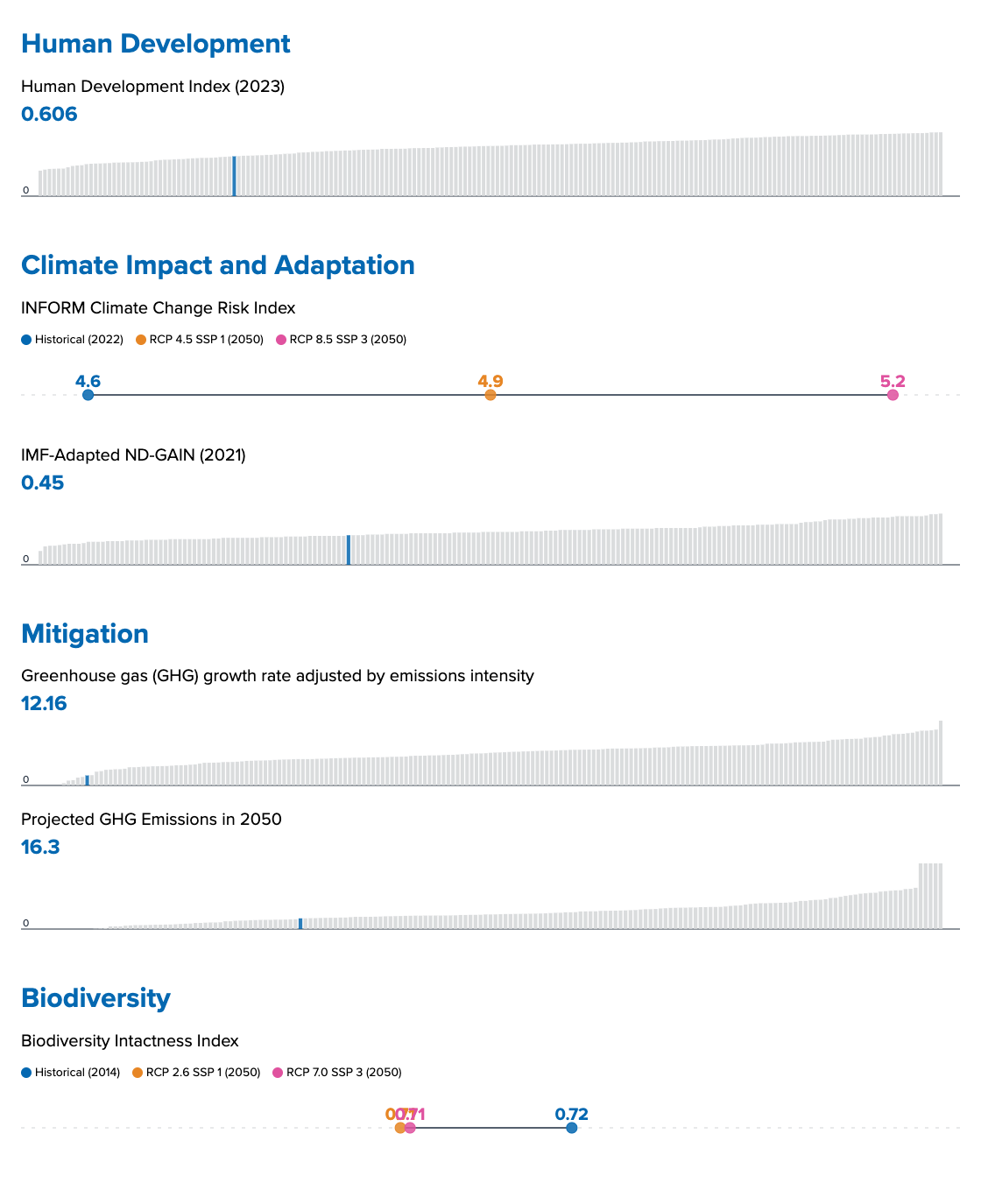
Sources European Commission 2023 (INFORM Climate Change Risk Index), IMF 2022 (IMF-Adapted ND-GAIN Index); Environmental Performance Index 2024 (GHG growth rate adjusted by emissions intensity & Projected Emissions in 2050); Helen Phillips; Adriana De Palma; Ricardo E Gonzalez; Sara Contu et al. 2021 (Biodiversity Intactness Index).
NDC x SDG Alignment
Goal Level
This analysis shows the most prominent SDGs in each of the two national strategies on climate and development. This identifies areas of common action and potential synergies across national climate and development priorities.
Nationally Determined Contributon (NDC)
Note: Based on Revised Nationally Determined Contribution (2021)
National Development Plan(s) (NDP)
Note: Based on: 1) Pentagonal Strategy-Phase I; 2) National Strategic Development Plan (NSDP) 2019-2023; 3) Mid-Term Review NSDP 2019-2023; 4) Rectangular Strategy Phase IV; 5) Pentagon Strategy 2024-2028 Phase I
These visuals are generated by analyzing the NDCs and National Development Plans through the SDG framework at goal level.
NDC x SDG Alignment
Target Level
This analysis shows how the country’s climate actions, both mitigation and adaptation, align with and drive impact across the SDGs at the target level.
Mitigation NDCs
Adaptation NDCs
These visuals are generated by analyzing NDC actions through a custom-built AI tool and categorized using the SCAN tool to surface relevant SDG synergies at the Goal level. For additional information on the NDC-SDG mapping, please visit: https://ambitiontoaction.net/scan_tool/
NDC x SDG Alignment
Action Level
This section breaks down the NDC categories into specific country commitments identified through a custom-built AI tool. The bubble sizes show how many actions fall under each category, helping pinpoint where NDC–SDG acceleration is most likely.
Cambodia 's NDC includes actions in these sectors:
Mitigation
Adaptation
3. NDC x SDG Interlinkages
NDC x SDG interlinkages reveal how climate actions can impact human development progress. Building from the country's NDC actions and SDG priorities, the following integrated SDG pathways reflect NDC actions with the most potential to accelerate the SDGs.
4. Finance & Stimulus
This section examines a country's fiscal space and public investment priorities, highlighting opportunities to align stimulus measures with SDG progress and accelerated climate action.
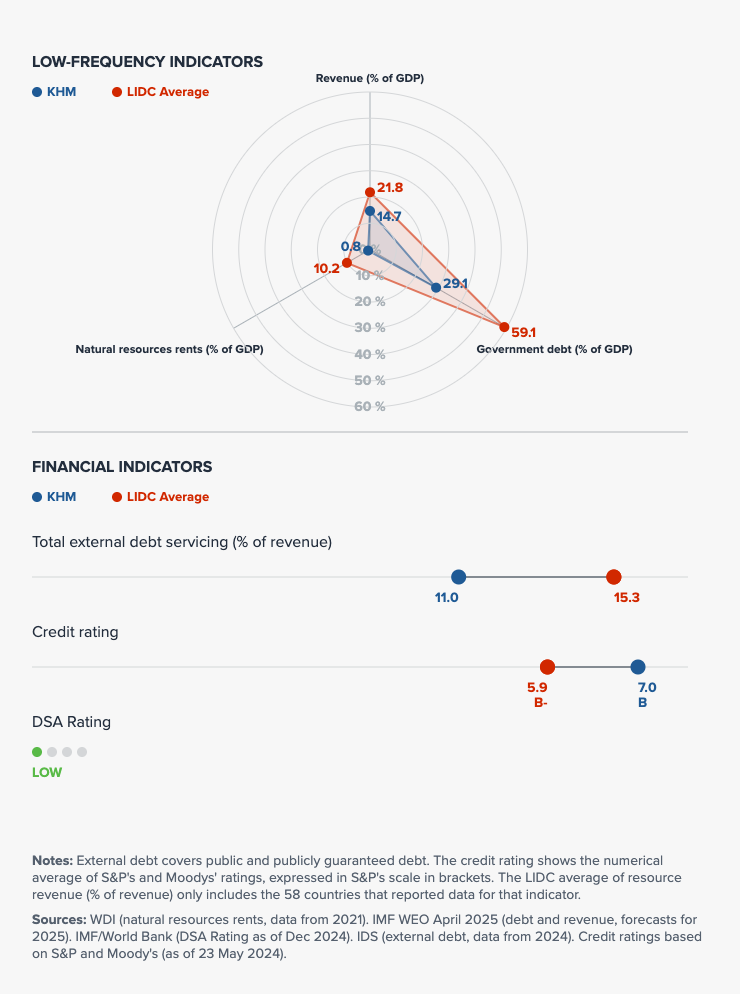
The radar diagram shows low frequency data points linked to government revenue, debt, and natural resources rents as a proportion of GDP. The financial indicator graphs show external debt servicing relative to revenue as well as the country’s latest Debt Sustainability Assessment (DSA) risk rating (IMF; WB, 2024).
Public Finance
Financing needs
SDGs: The additional annual costs required to achieve the SDGs in Cambodia, The cumulative value of this estimated gap is approximately USD 18 billion per year.
NDC: Total: Estimated 7.7 billion USD total by 2030
- 5.7 billion USD for mitigation
- 2 billion USD for adaptation
Financing strategy
Financing strategy under development for Pentagon Strategy and NDCs to achieve:
- CSDGs and High-Income Status by 2050
- LT-LEDS / Carbon Neutrality by 2050
Sources: Financing Needs for SDGs data from National Financing Policy Framework (2nd Draft, June 2024)
Expenditures & budgets
- Climate expenditure budgeted (focus on vulnerable households)
- Investment in forest protection to curb emissions
- Phase out of fossil fuel subsidies by 2030 (currently 3.2% of GDP)
Debt instruments
- In November 2023, the Government endorsed the “Policy Framework on the Development of Government Securities 2023 – 2028” aiming to establish a well-functioning government securities market.
- Although sovereign thematic bond issuance is not expected soon, the groundwork laid by development partners for the Cambodian Government, through studies, capacity-building efforts, and technical assistant, has created the conditions needed to move forward.
International climate finance
- GCF: Over 245 million total to date
- GEF: Approx. 18 million total for climate change to date (GEF4-8)
- Adaptation Fund: Approx. 20 million total to date
Private Finance & Economy
Policy & Regulatory Measures:
Innovative Instruments:
While Cambodia's first thematic bond issuance is not expected soon, development partners including UNDP has laid the groundwork through studies, capacity-building, and expert consultations.
Cambodia has launched several blended finance initiatives to promote sustainable development. The Clean Energy Revolving Fund offers loans to farmers for clean energy adoption. The WASH sector explores private investment alongside public funds for improved water and sanitation. The Investment Support Facility for Post-Harvest Fisheries by UNIDO and CGCC, co-funded by the EU, blends financing to boost fisheries productivity. And the Sustainable Green Financing Facility, launched in October 2024 by CGCC and UNDP, supports green projects through a public-private funding mix.
However, limitations remain, including low private sector participation, regulatory challenges, and capacity constraints in structuring and managing blended finance mechanisms. Ensuring long-term success will require stronger policy frameworks, incentives for private investment, and improved coordination among stakeholders.
International Investment:
Foreign Direct Investment accounts for 46.46 per cent of the approved 186 investment projects in 2022. Major foreign investors came from China, Thailand and Japan.
Domestic Investment:
Local investment accounts for 53.54 per cent of the approved 186 investment projects in 2022.
SDG Investor Map
SDG Investor Map Investment Opportunity Areas (IOAs) that contribute to the government's NDC priorities and meet SDG needs.
The priority IOAs span 15 Investment Opportunity Areas (IOAs) that contribute to the government’s NDC priorities and meet SDG needs. The priority IOAs span 4 climate adaptation-relevant sectors in Cambodia: climate-relevant sectors in Cambodia: