Hero image
Back to main site

Integrated
NDC X SDG Insights
El Salvador


NDC x SDG Insights leverages data, AI, and systems analysis to identify
acceleration pathways and uncover systemic barriers to climate action,
positioning climate as a key driver of SDG achievement and informing the NDC 3.0 process.


Download as PDF

How To Read This Report

The NDC x SDG approach focuses on identifying the key interlinkages and pathways through which priority climate actions can accelerate a country’s most vital development goals. In doing so, it helps craft a clear, evidence-based narrative that brings together broad coalitions across government to drive coordinated progress.

The report is divided into four categories of analysis →

  • NDC x SDG Moment — human progress within planetary boundaries is the next development frontier. This section provides a snapshot of key climate and human development data.
  • NDC x SDG Alignment — maps climate commitments and national development priorities using custom machine learning tool that draws from an SDG vocabulary of 100k terms.
  • NDC x SDG Interlinkages — identifies national-level actions through enhanced NDCs that accelerate SDG achievement and advances a robust development case.
  • Finance & Stimulus — charts fiscal constraints and stimulus opportunities to ensure climate and development policy choices can be advanced with greatest impact.

1. NDC x SDG Moment

This section takes stock of the country’s current climate and sustainable development context, providing a clear snapshot of key climate and human development data and setting the scene to identify climate–development synergies.

As part of their mitigation measures, El Salvador has set a target of reducing emissions of up to

819 KtCO₂e
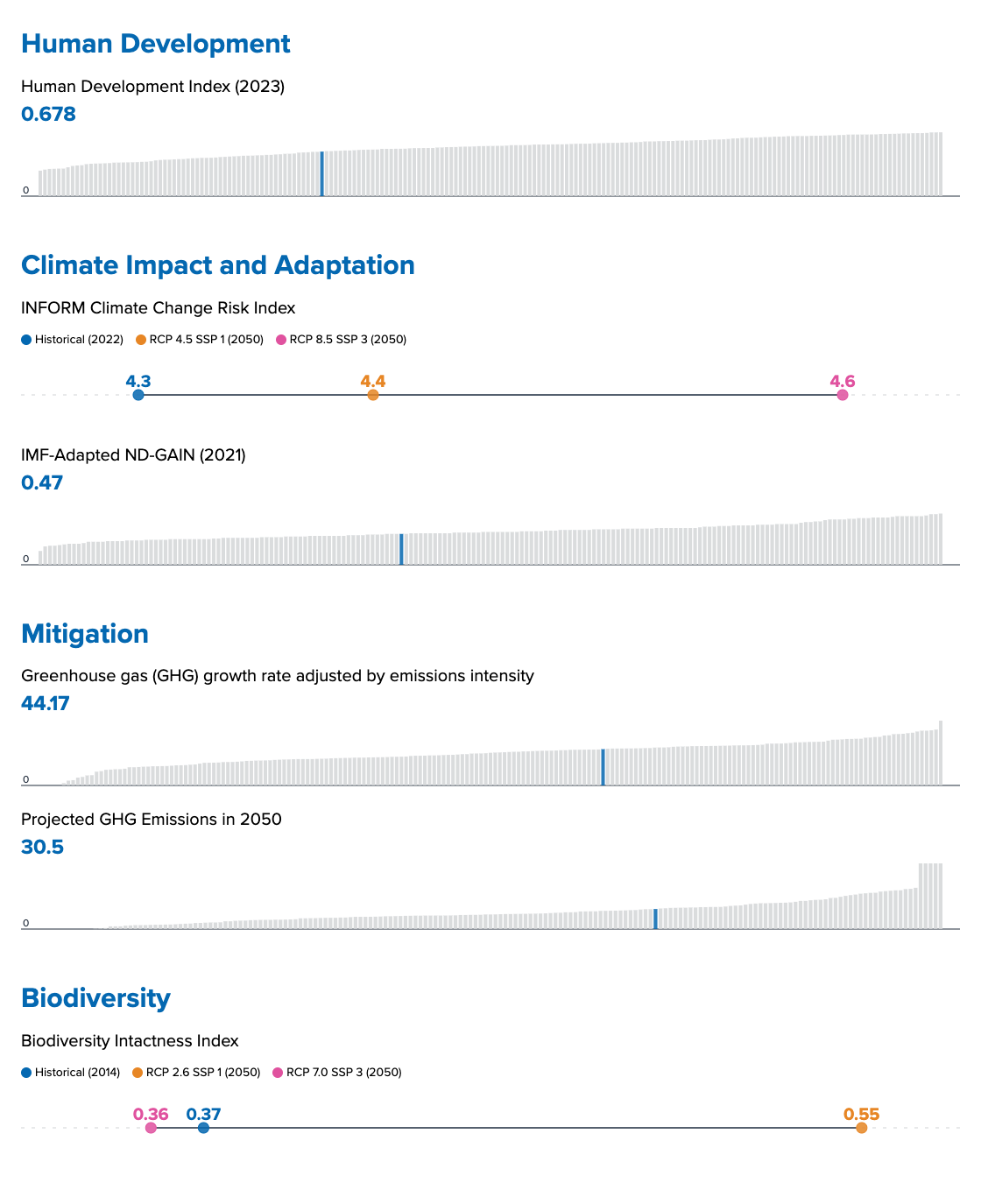
Human activities are causing significant climate change with severe environmental and socio-economic consequences. Integrating climate action for emissions reduction and enhanced resilience into development strategies can advance human development and provide multiple co-benefits.

The National Comprehensive Development Strategy 2023 seeks to promote the economic, social and cultural transformation of El Salvador, through accelerated, resilient and inclusive growth. The pillars of acceleration are strengthening human capacities; transforming the productive matrix; guaranteeing food, water and the protection of the biosphere; and innovation, clean energy and sustainable communities.

El Salvador is in medium human development category (132 out of 193 countries and territories) and the country’s IMF Adapted ND-GAIN Index indicates vulnerability to climate disruptions and challenges in leveraging investments to adaptation actions. With a projected emissions score of 30.5/100 in 2050, El Salvador may need additional investments in achieving carbon neutrality.

El Salvador scores 4.3 out of 10 on the INFORM Climate Change Index, reflecting a medium risk due to climate change impacts. It is projected that this score will increase to 4.4 (SSP1/RCP4.5) and 4.6 (SSP3/RCP8.5) by 2050. The country also scores 0.472 on the 0-1 IMF-adapted ND-Gain Index, indicating moderate vulnerability to climate disruptions and readiness to leverage investments to adaptation actions.

The implementation of climate change adaptation and mitigation measures established in the NDC contributes to reducing the vulnerability of key sectors for economic and social development, reducing financing needs and maintaining the path of reducing multidimensional poverty.

El Salvador data visualization

Sources European Commission 2023 (INFORM Climate Change Risk Index), IMF 2022 (IMF-Adapted ND-GAIN Index); Environmental Performance Index 2024 (GHG growth rate adjusted by emissions intensity & Projected Emissions in 2050); Helen Phillips; Adriana De Palma; Ricardo E Gonzalez; Sara Contu et al. 2021 (Biodiversity Intactness Index).

NDC x SDG Alignment

Goal Level

This analysis shows the most prominent SDGs in each of the two national strategies on climate and development. This identifies areas of common action and potential synergies across national climate and development priorities.

Nationally Determined Contributon (NDC)

Note: Based on Revised Nationally Determined Contribution (2021)

National Development Plan(s) (NDP)

Note: Based on National Development Plan 2023-2025 (2023)

These visuals are generated by analyzing the NDCs and National Development Plans through the SDG framework at goal level.

NDC x SDG Alignment

Target Level

This analysis shows how the country’s climate actions, both mitigation and adaptation, align with and drive impact across the SDGs at the target level.

Mitigation NDCs

Adaptation NDCs

These visuals are generated by analyzing NDC actions through a custom-built AI tool and categorized using the SCAN tool to surface relevant SDG synergies at the Goal level. For additional information on the NDC-SDG mapping, please visit: https://ambitiontoaction.net/scan_tool/

NDC x SDG Alignment

Action Level

This section breaks down the NDC categories into specific country commitments identified through a custom-built AI tool. The bubble sizes show how many actions fall under each category, helping pinpoint where NDC–SDG acceleration is most likely.

El Salvador 's NDC includes actions in these sectors:

Mitigation
Adaptation

3. NDC x SDG Interlinkages

NDC x SDG interlinkages reveal how climate actions can impact human development progress. Building from the country's NDC actions and SDG priorities, the following integrated SDG pathways reflect NDC actions with the most potential to accelerate the SDGs.

SDG 11.3

Inclusive and sustainable urbanization

El Salvador is taking significant steps to prioritize climate resilience by integrating a variety of adaptation measures aimed at enhancing both infrastructure and social frameworks. One of the key initiatives focuses on developing climate-resilient infrastructure, particularly road systems designed to withstand extreme weather events. This approach not only ensures uninterrupted connectivity to essential services during emergencies but also plays a critical role in reducing economic losses and mitigating the broader impacts of climate change.

In tandem with infrastructure improvements, El Salvador is implementing land restoration programs that actively engage vulnerable communities. These initiatives not only contribute to ecological recovery but also promote social cohesion and sustainable urban development, fostering a sense of community and shared purpose. A cornerstone of El Salvador’s climate resilience strategy is inclusive decision-making. By involving women, indigenous populations, and rural communities, the country is reinforcing gender equality and enhancing community participation. This inclusive approach ensures that diverse perspectives are considered, strengthening governance and fostering peaceful societies.

These efforts directly contribute to several Sustainable Development Goals (SDGs). For instance, they enhance access to healthcare during emergencies and reduce health impacts from climate-related disruptions (SDG 3). They empower women through their involvement in decision-making and urban development projects (SDG 5), and tackle inequalities by ensuring fair access to resources for marginalized groups (SDG 10). The focus on resilient urban systems and sustainable urban development directly supports SDG 11, while strengthening governance and community participation aligns with SDG 16.

Overall, these initiatives not only improve healthcare access and conserve biodiversity, but they also support a resilient ecological and social system that is better equipped to face the challenges of climate change.

Priority NDC Activities
Activity 1

Adaptation Measures for Road and Pavement Structures in the face of Climate Variability

Activity 2

Resilient road infrastructure to address geohazards from climate change

Activity 3

Land Restoration with inclusive participation of vulnerable communities, indigenous peoples, and generational change principles

NDC synergies with the priority SDGs
SDG 11.6

Reduce the environmental impacts of cities

El Salvador is charting a course towards sustainable urban development by focusing on creating adaptable, resilient, and low-emission cities. A critical component of this strategy is promoting sustainable urban planning, which encourages efficient land use and spatial organization. These efforts aim to improve access to essential socioeconomic services, such as employment, transportation, and recreational opportunities. By supporting climate-resilient urban design, El Salvador aims to reduce vulnerability to climate impacts and ease pressure on natural resources. Additionally, the integration of low-carbon infrastructure, including sustainable transport systems, plays a key role in reducing fossil fuel use, improving air quality, and mitigating climate change.

In line with these urban planning efforts, El Salvador is also emphasizing efficient waste management and circular economy practices. By adopting circular economy approaches that focus on recycling and minimizing waste, the country conserves resources and reduces urban pollution. These practices not only enhance public health—contributing to SDG 3 by lowering exposure to hazardous chemicals and improving the urban environment—but also engage vulnerable communities in waste management. This engagement fosters social cohesion, aligns with SDG 16, and promotes gender equality as outlined in SDG 5.

These initiatives have a direct impact on several Sustainable Development Goals (SDGs). They advance sustainable and resilient urban systems (SDG 11), enhance public health through pollution reduction (SDG 3), and empower marginalized groups and women by facilitating inclusive participation (SDG 5). Additionally, these efforts contribute to reducing inequalities in access to sustainable resources and benefits (SDG 10) and protect urban ecosystems and biodiversity (SDG 15).

Through these comprehensive measures, El Salvador is laying the groundwork for urban environments that are not only sustainable and resilient but also inclusive and low-emission, ensuring a healthier and more equitable future for all its citizens.

Priority NDC Activities
Activity 1

Adaptable, Resilient, and Low-Emission Cities in El Salvador for Sustainable Urban Development

Activity 2

Comprehensive support for waste management in 262 Districts in 44 Municipalities: Capacity Building, Local Waste System Development, Solid Waste Collection, 3Rs Promotion, Circular Economy and Equipment for Efficient Waste Management

NDC synergies with the priority SDGs
SDG 3.9

Reduce illnesses and deaths from hazardous chemicals and pollution

The approval and implementation of the General Water Resources Law in El Salvador marks a significant advancement in the governance of water resources, fostering equitable and transparent management practices. This law promotes inclusive decision-making by actively engaging a diverse array of stakeholders, including marginalized communities. By doing so, it helps to reduce potential conflicts over water access and usage, thereby fostering peaceful coexistence among various users.

In addition to governance improvements, El Salvador is focused on optimizing agricultural practices. This involves encouraging collaboration between farmers, policymakers, and local organizations to enhance sustainable food production. By reducing reliance on harmful chemicals, this initiative ensures that agricultural practices are safe and equitable. Furthermore, these adjustments build resilience against climate change, helping to mitigate risks associated with resource-based disputes.

The efforts tied to the General Water Resources Law and agricultural optimization have a direct impact on several Sustainable Development Goals (SDGs). For instance, they improve public health by reducing pollution-related illnesses (SDG 3) and promote gender equality by involving women and marginalized groups in decision-making and resource management (SDG 5). Additionally, these initiatives contribute to reducing inequalities by ensuring fair access to essential water resources (SDG 10) and support sustainable urban development through enhanced access to clean water and improved resilience in urban areas (SDG 11).

Moreover, these practices are aligned with SDG 14, as they protect aquatic ecosystems through sustainable methods, and strengthen institutions, promote inclusive decision-making, and foster peaceful societies, which is in line with SDG 16. There are also contributions to food security and responsible consumption, connecting to both SDG 2 and SDG 12.

Overall, these actions not only build climate resilience and reduce inequalities but also promote long-term environmental sustainability, playing a vital role in contributing to peaceful and inclusive societies within El Salvador.

Priority NDC Activities
Activity 1

Approval and start of implementation of the General Law on Water Resources

Activity 2

Climate adaptation for agriculture and livestock in 87 municipalities, benefitting 5,000 producers in Usulután, San Miguel, La Unión and Morazán

NDC synergies with the priority SDGs

4. Finance & Stimulus

This section examines a country's fiscal space and public investment priorities, highlighting opportunities to align stimulus measures with SDG progress and accelerated climate action.

Public finances are constrained by public debt. The non-financial public sector debt balance, excluding pensions, was 57.3% of GDP in September 2024, and grew 4.4% compared to the end of 2023. The pension debt balance is approximately 29.2% of GDP. The country risk, measured by the emerging market bond index, was 4.2 points on December 4th, 2024.
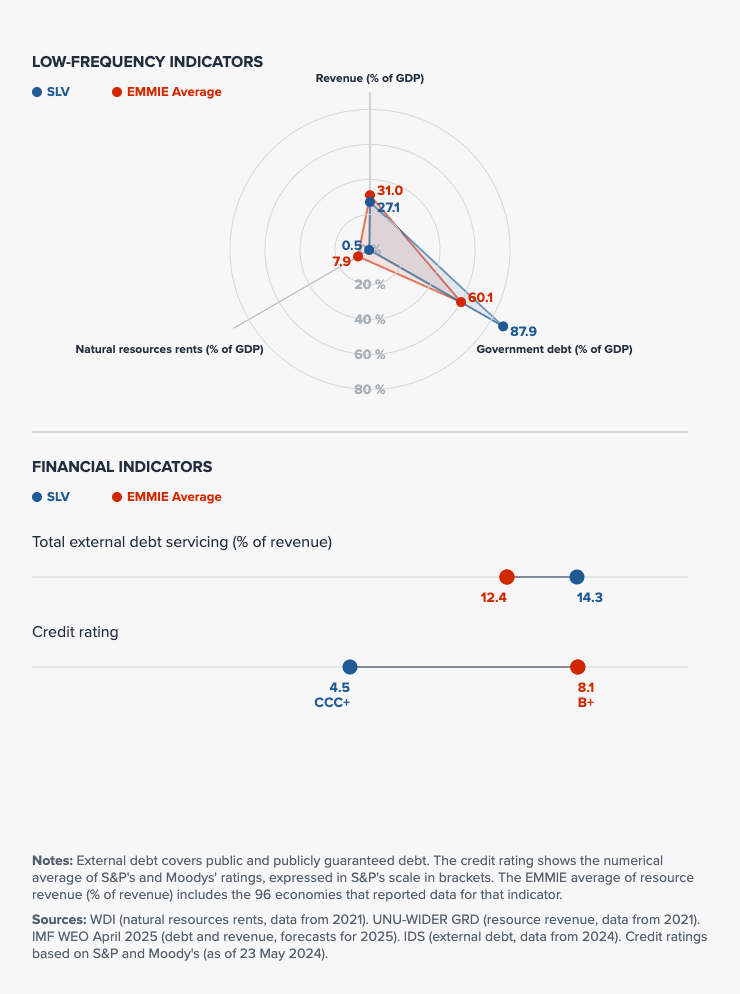
The government presented the 2025 budget proposal that will not require borrowing for public expenditure. In addition, the government has bought back Salvadoran debt bonds, and in the last operation decided that the savings will be invested in the restoration of the country's main river.

The government's current priority is the economy, particularly accelerating economic growth. The Salvadoran economy is characterized by low growth with an average of 2.1% in 1991 -2020. In 2023, the economy grew 3.5% and is projected to grow 3.0% in 2024. The economy is highly dependent on remittances, which accounted for 24.1% of GDP in 2023.

Fiscal indicators visualization

Public Finance

Financing needs

NDC: Total: Estimated $1.05 billion USD total by 2030

  • Mitigation: $712.1m
  • Adaptation: $333.9m
  • Integrated Climate Strategies: $4.96m

Financing strategy

Financing Strategy: Double Dividend Climate Financing

  • El Salvador's climate financing strategy is centered on the Double Dividend Climate Financing approach, which aims to achieve both economic growth and environmental sustainability. This strategy focuses on mobilizing resources through innovative instruments, such as green bonds, blended finance, and public-private partnerships, to:
  • Enhance Economic Development: Invest in renewable energy, sustainable agriculture, and low-carbon infrastructure to create jobs, stimulate local economies, and improve livelihoods.
  • Achieve Climate Goals: Direct funding towards mitigation and adaptation projects that reduce emissions, enhance resilience, and safeguard ecosystems in alignment with NDC targets

Expenditures & budgets

The Ministry of Finance, supported by UNDP, is implementing the Climate Budget Tagging methodology to align national budgets with climate objectives, and Biodiversity Finance Initiative (BIOFIN): Supports identifying and mobilizing resources for biodiversity conservation.

Debt instruments

In 2024, El Salvador completed the largest debt-for-nature swap, with over $1bn , including $350m allocated to the Lempa River watershed restoration

The first social bond in El Salvador is issued with IDB Invest and Fedecrédito, totaling $80m. An initial $40m tranche includes $20m subscribed by IDB Invest, with co-investors covering the remainder.

International climate finance

El Salvador has benefited from GEF funding to support projects in biodiversity, climate change mitigation, and adaptation. Total GEF financing is $9.6m, with $8m explicitly dedicated to climate change.

The country accesses GCF resources for projects in renewable energy, sustainable agriculture, and water management. Total GCF financing is $112.8 million.


Sources: BIOFIN (Accessed Dec 2024); Reuters (2024); IDB Invest (2024); GEF (Accessed 2024); GCF (Accessed 2024)

Private Finance & Economy

Policy & Regulatory Measures:

Sources Green Finance for Latin America and the Caribbean (Accessed Dec 2024); AES El Salvador Sustainability Report 2023; UNSDG, Unlocking the data dividend for the SDGs in El Salvador (2024).

Innovative Instruments:

La Cuenta del Mar (Banco Agrícola). Protects mangroves through a partnership with Mastercard and Fundación Doménech.

FIAES Environmental Fund: FIAES mobilizes resources to finance conservation and sustainable agriculture projects, mitigating risks for private sector investments while fostering community resilience.

Energy Efficiency Financing Facility (The Development Bank of El Salvador, BANDESAL), Provides concessional loans, technical validation, and energy savings insurance for Small and Medium-sized Enterprises. Supported by IDB and the Green Climate Fund.

International Investment:

El Salvador participates in global programs such as EUROCLIMA (€1.1 million), the Green Climate Fund (GCF, $57.5 million), and the Global Environment Facility (GEF, $5.13 million), securing a total of approximately $63 million for renewable energy, sustainable agriculture, and climate resilience initiatives.

Domestic Investment:

The significant improvement in security has had a positive impact on the business climate and private investment.

SDG Investor Map

El Salvador presents 11 Investment Opportunity Areas (IOAs) aligned with its NDC priorities and SDGs. Key sectors include:

  • Renewable Energy, focusing on solar, wind, and geothermal projects (SDGs 7, 13)
  • Sustainable Agriculture, promoting climate-resilient farming and agroforestry (SDGs 2, 12, 15).
  • Green Urban Infrastructure investments target low-emission buildings, sustainable public transport, and efficient waste management (SDGs 9, 11, 13).
  • Circular Economy emphasizes recycling facilities and reduced plastic pollution (SDGs 6, 12, 14).
  • Innovative Financial Instruments like green bonds and public-private partnerships mobilize resources for climate action (SDG 17).

Development Breakthrough
Policy Brief

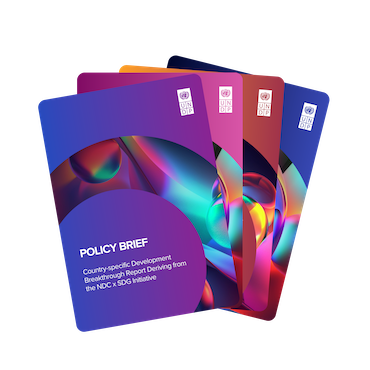
Each NDC x SDG Insights policy brief is a focused, country-specific deep dive that builds on the broader Insights report to unpack a single development breakthrough, outlining its policy implications and the SDG-positive actions driving it forward.
Read El Salvador's Policy Brief
Development Breakthrough Policy Brief

Explore other NDC x SDG Insights