How To Read This Report
The NDC x SDG approach focuses on identifying the key interlinkages and pathways through which priority climate actions can accelerate a country’s most vital development goals. In doing so, it helps craft a clear, evidence-based narrative that brings together broad coalitions across government to drive coordinated progress.
The report is divided into four categories of analysis →
- NDC x SDG Moment — human progress within planetary boundaries is the next development frontier. This section provides a snapshot of key climate and human development data.
- NDC x SDG Alignment — maps climate commitments and national development priorities using custom machine learning tool that draws from an SDG vocabulary of 100k terms.
- NDC x SDG Interlinkages — identifies national-level actions through enhanced NDCs that accelerate SDG achievement and advances a robust development case.
- Finance & Stimulus — charts fiscal constraints and stimulus opportunities to ensure climate and development policy choices can be advanced with greatest impact.
1. NDC x SDG Moment
This section takes stock of the country’s current climate and sustainable development context, providing a clear snapshot of key climate and human development data and setting the scene to identify climate–development synergies.
As part of their mitigation measures, Liberia has set a target of reducing emissions by
15.7 MtCO₂e
64%
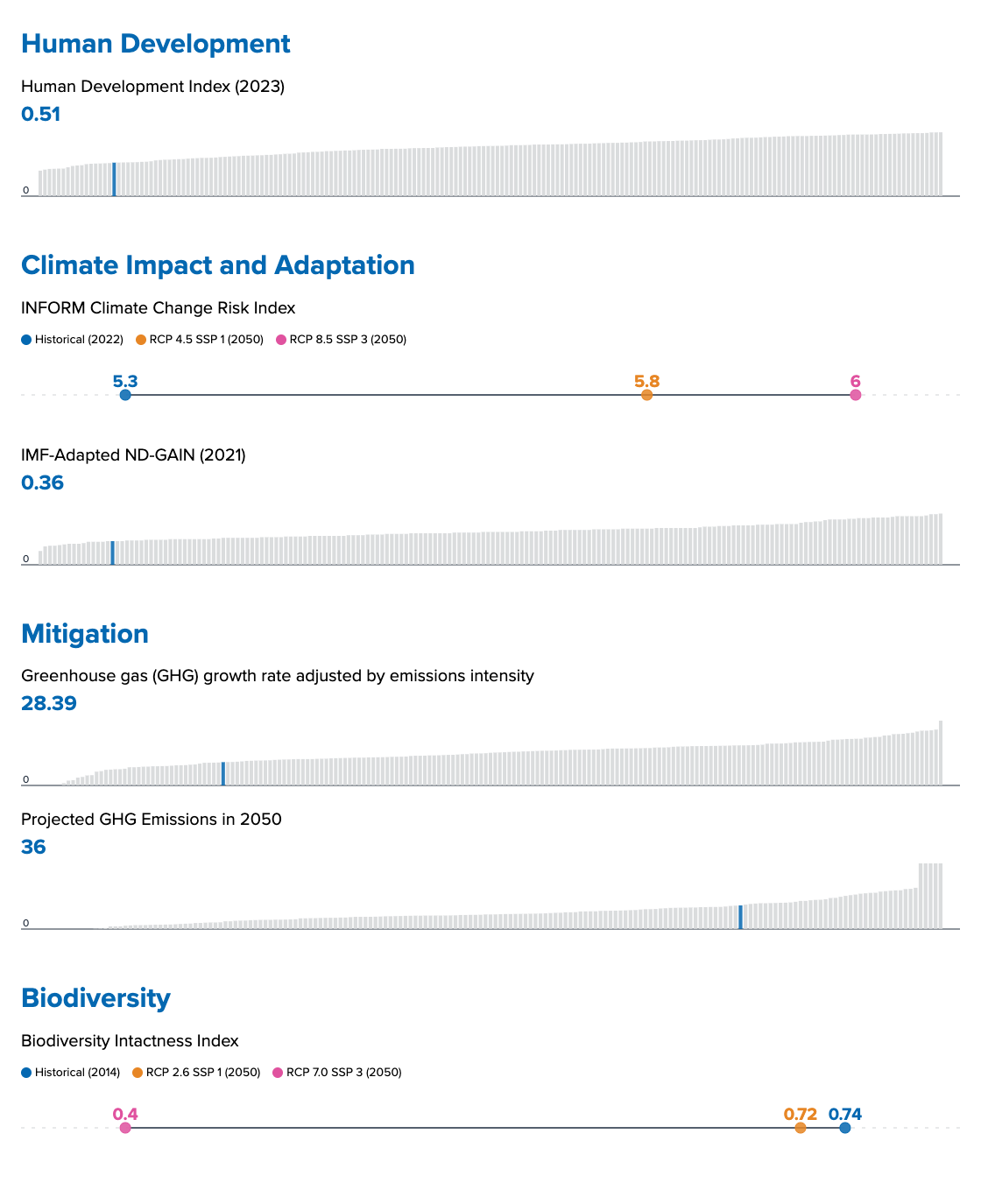
Sources European Commission 2023 (INFORM Climate Change Risk Index), IMF 2022 (IMF-Adapted ND-GAIN Index); Environmental Performance Index 2024 (GHG growth rate adjusted by emissions intensity & Projected Emissions in 2050); Helen Phillips; Adriana De Palma; Ricardo E Gonzalez; Sara Contu et al. 2021 (Biodiversity Intactness Index).
NDC x SDG Alignment
Goal Level
This analysis shows the most prominent SDGs in each of the two national strategies on climate and development. This identifies areas of common action and potential synergies across national climate and development priorities.
Nationally Determined Contributon (NDC)
Note: Based on Revised Nationally Determined Contribution (2021)
National Development Plan(s) (NDP)
Note: Based on National Development Plan 2025-2029: ARREST Agenda for Inclusive Development (AAID)
These visuals are generated by analyzing the NDCs and National Development Plans through the SDG framework at goal level.
NDC x SDG Alignment
Target Level
This analysis shows how the country’s climate actions, both mitigation and adaptation, align with and drive impact across the SDGs at the target level.
Mitigation NDCs
Adaptation NDCs
These visuals are generated by analyzing NDC actions through a custom-built AI tool and categorized using the SCAN tool to surface relevant SDG synergies at the Goal level. For additional information on the NDC-SDG mapping, please visit: https://ambitiontoaction.net/scan_tool/
NDC x SDG Alignment
Action Level
This section breaks down the NDC categories into specific country commitments identified through a custom-built AI tool. The bubble sizes show how many actions fall under each category, helping pinpoint where NDC–SDG acceleration is most likely.
Liberia 's NDC includes actions in these sectors:
Mitigation
Adaptation
3. NDC x SDG Interlinkages
NDC x SDG interlinkages reveal how climate actions can impact human development progress. Building from the country's NDC actions and SDG priorities, the following integrated SDG pathways reflect NDC actions with the most potential to accelerate the SDGs.
4. Finance & Stimulus
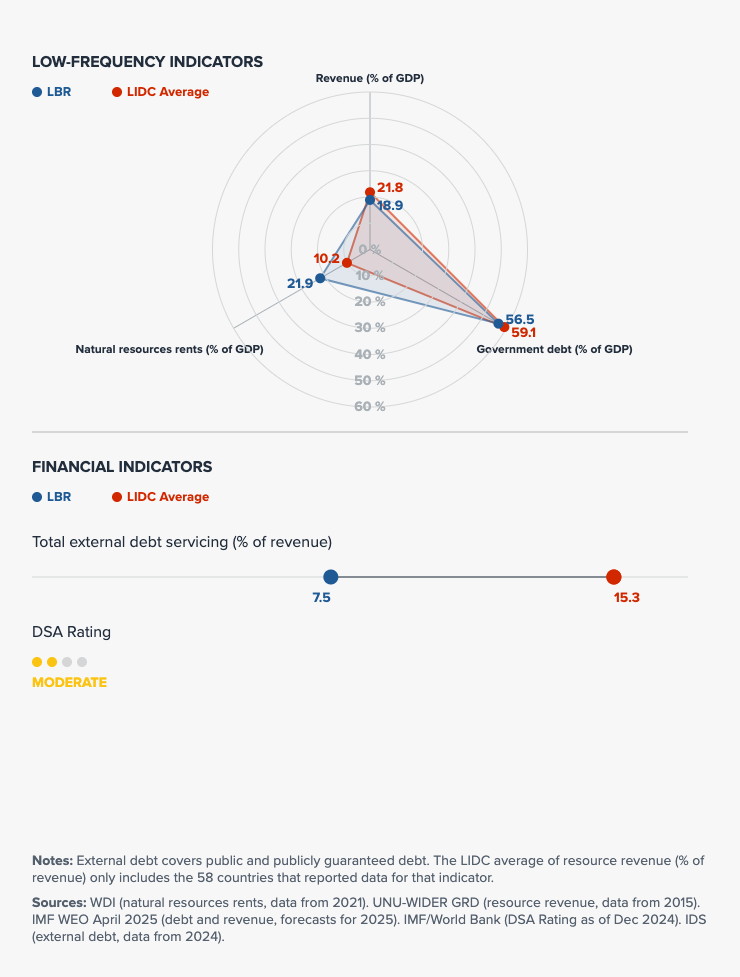
This section examines a country's fiscal space and public investment priorities, highlighting opportunities to align stimulus measures with SDG progress and accelerated climate action.
Many countries are facing reduced fiscal space, high debt levels, rising interest rates and downgrades on credit ratings. Fiscal and financial constraints tend to slow or even reverse SDG progress.
Public Finance
Financing needs
SDGs: Over 15-20 million USD per annum in capital investment is required to reach growth targets necessary for achieving the SDGs in Liberia
NDC: Total: Estimated 2.5-3 billion USD total by 2030.
- 1.8 billion USD for mitigation efforts
- 0.6 billion USD for adaptation strategies
- 0.1 billion USD for capacity-building actions
Financing strategy
Financing strategy under ARREST Agenda for Inclusive Development and NDCs to achieve:
- Middle Income Status by 2030
- Carbon Neutrality by 2050
Sources: Financing Needs for SDGs data from Sustainable Devleopment Report 2024 and Liberia Project Dashboard. Financing Strategy from National Development Plan 2025-2029
Expenditures & budgets
Budgetary expenditure amounted to USD 2.56 billion with climate change expenditure accounting for US$292m over 2012-17, or US$58.6m/year on CC; Infrastructure 64%, Energy & Environment 24%, Agriculture 10%. Climate change expenditure represents roughly 1.8% of GDP during this period.
From 2012 to 2017 the actual domestic budgetary expenditure amounted to USD 2.56 billion with climate change expenditure accounting for USD 292.8 million. Compared to the average Liberia GDP of USD 3.2 billion, the climate change expenditure represents roughly 1.8% of GDP
Debt instruments
Total development finance to Liberia between 2002-2018 totalled USD 13.4 billion (AidAtlas 2021). This was drawn from a combination of bilateral and multilateral sources. Total committed development finance targeting climate change over the same period totalled USD 371 million, or less than 3% of total Liberian development finance. In terms of financial instruments, 100% of bilateral funding took the form of grants, while only 46% of multilateral funding were grants, the balance (54%) being loans, including concessional finance.
International climate finance
Liberia's NDC costs for 2021-2025 are estimated at USD 490.6 million, or USD 98.1 million per year. Approximately 82% or USD 400.5 million of these costs are for mitigation activities, with approximately 18% or USD 90 million for adaptation measures. International climate finance mobilized since 2018 is estimated at 493.48m, out of which 157.19 have been disbursed as of Q3 2024. This includes GCF 25.6m, GEF 20.4m, Norway-36.7m
Private Finance & Economy
Policy & Regulatory Measures:
Innovative Instruments:
In addition to its National budget, Liberia has accessed several climate financing instruments to support its climate change mitigation and adaptation efforts, notably Green Climate Fund, Global Environment Facility, Climate Investment Funds, and International Climate Finance.
There are also climate financing instruments that Liberia may be eligible to access but is not currently accessing: Examples include: Green Bonds, Climate-Resilient Bonds, Sustainable Development Bonds, Blue Bonds, Climate Venture Capital, Impact Investing, and Carbon Credits.
While Liberia continues to explore many of these climate finance instruments, creating a sort of public pipeline would help. A climate finance pipeline is a critical tool for countries to identify, develop, and finance climate-friendly projects. Inline with the National Development Plan, the pipeline could be around: Renewable energy, sustainable agriculture, forestry and land use, climate-resilient infrastructure and disaster risk reduction.
International Investment:
Liberia's economy is market-based and largely dependent on natural resources, foreign aid, and foreign direct investment (FDI). FDI constitutes 88% (mining and agriculture), while SMEs, MSMEs, Informal Sector account for 12% of GDP. Foreign direct investment, net inflows (% of GDP) in Liberia was reported at 17.19 % in 2023, according to the World Bank.
Domestic Investment:
Liberia’s domestic private investment is evolving, with a focus on strengthening financial services and fostering green entrepreneurship. However, limited capital access and underdeveloped markets highlight the need for stronger financial infrastructure and private sector support. For example, despite the agriculture sector representing approximately 70% of Liberia’s GDP, Central Bank of Liberia (CBL) data shows that less than 4% of Liberian commercial bank’s loans are to the sector.