Hero image
Back to main site

Integrated
NDC X SDG Insights
Nigeria


NDC x SDG Insights leverages data, AI, and systems analysis to identify
acceleration pathways and uncover systemic barriers to climate action,
positioning climate as a key driver of SDG achievement and informing the NDC 3.0 process.


Download as PDF

How To Read This Report

The NDC x SDG approach focuses on identifying the key interlinkages and pathways through which priority climate actions can accelerate a country’s most vital development goals. In doing so, it helps craft a clear, evidence-based narrative that brings together broad coalitions across government to drive coordinated progress.

The report is divided into four categories of analysis →

  • NDC x SDG Moment — human progress within planetary boundaries is the next development frontier. This section provides a snapshot of key climate and human development data.
  • NDC x SDG Alignment — maps climate commitments and national development priorities using custom machine learning tool that draws from an SDG vocabulary of 100k terms.
  • NDC x SDG Interlinkages — identifies national-level actions through enhanced NDCs that accelerate SDG achievement and advances a robust development case.
  • Finance & Stimulus — charts fiscal constraints and stimulus opportunities to ensure climate and development policy choices can be advanced with greatest impact.

1. NDC x SDG Moment

This section takes stock of the country’s current climate and sustainable development context, providing a clear snapshot of key climate and human development data and setting the scene to identify climate–development synergies.

As part of their mitigation measures, Nigeria has set a target of reducing emissions by

21%

(by 2030)
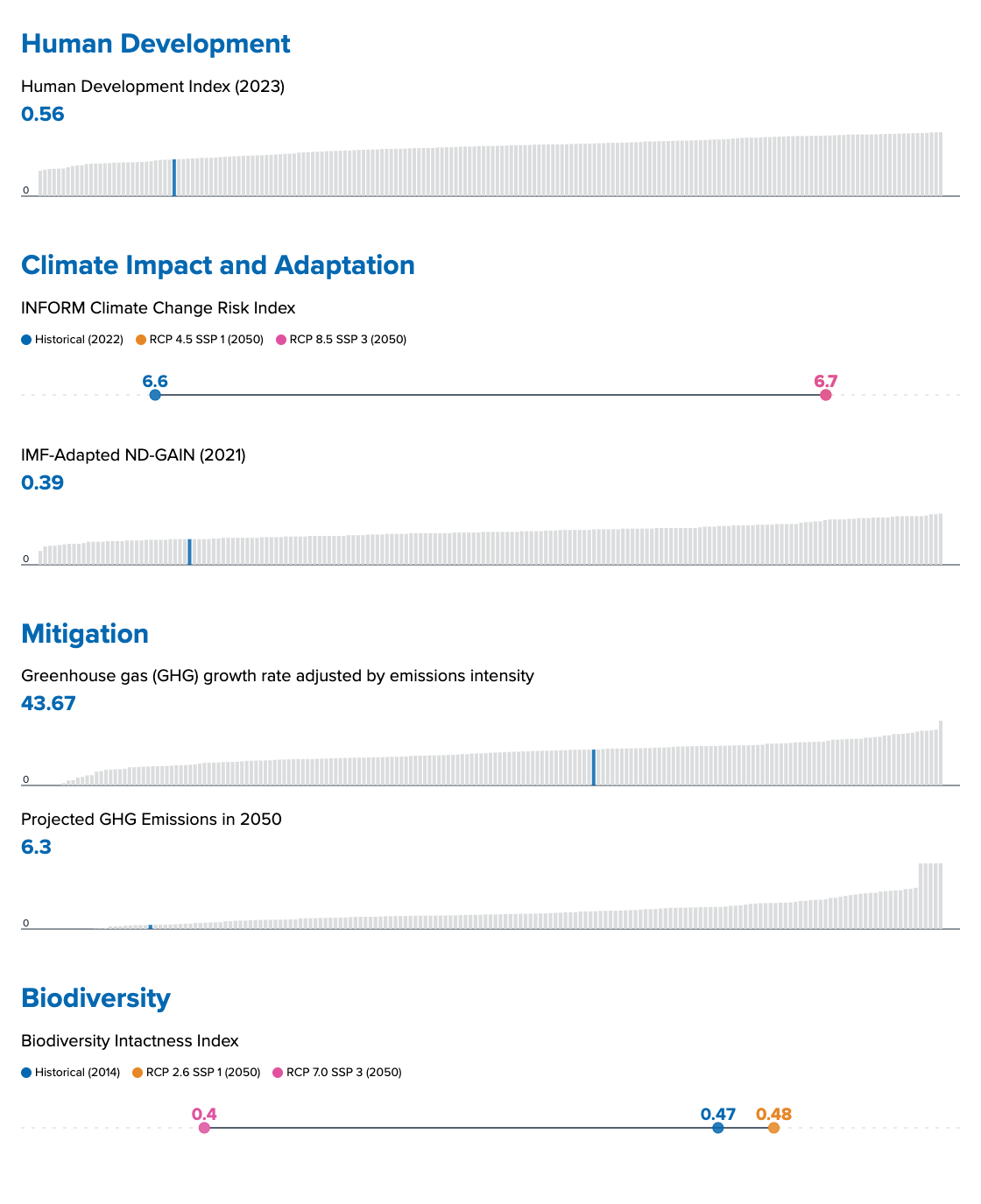
Human activities are causing significant climate change with severe environmental and socio-economic consequences. Integrating climate action for emissions reduction and enhanced resilience into development strategies can advance human development and provide multiple co-benefits.

All countries are navigating through a period of profound global uncertainty and shrinking development space that is affecting the landscape of global growth. The vulnerability of debt is at its highest level in decades in many developing economies, coinciding with a period when donors are making substantial cuts to aid flows. With these global challenges, it’s important to leverage finance and resources nationally to drive development priorities.

Nigeria is in the medium human development category (164th of 193 countries) and the country’s IMF Adapted ND-GAIN index indicates vulnerability to climate disruptions and some challenges to leveraging investments to adaptation actions. With a score of 6.3/100 for projected emissions levels in 2050, Nigeria is making progress towards achieving carbon neutrality. Nigeria’s projected Biodiversity Intactness Index indicates potential negative impact on biodiversity in 2050 under higher climate forcing scenarios.

The Nigerian government’s long-term economic and social development plans are outlined in the Agenda 2050, which has the ambition to transform the country into an upper-middle-income economy by 2050. The government’s economic transformation is through stable macroeconomic policies to enhance private-sector driven economic activities; investments in education, healthcare, job creation and social protection programmes; advancing environmental sustainability with green and circular economy strategies; ensuring regional equity so as to have balanced development.

Nigeria aims to reduce its greenhouse gas emissions by 24% compared to the reference year 2022 by the year 2035. Nigeria’s transition is strongly aligned with its development plans. Climate change is affecting the economy of Nigeria due to loss and damage to infrastructure, farmland, real estate and human settlements. Adaptation is therefore critical to protect and safeguard the Nigerian economy and society from future climatic extreme events while preventing loss and damage.

Nigeria data visualization

Sources European Commission 2023 (INFORM Climate Change Risk Index), IMF 2022 (IMF-Adapted ND-GAIN Index); Environmental Performance Index 2024 (GHG growth rate adjusted by emissions intensity & Projected Emissions in 2050); Helen Phillips; Adriana De Palma; Ricardo E Gonzalez; Sara Contu et al. 2021 (Biodiversity Intactness Index).

NDC x SDG Alignment

Goal Level

This analysis shows the most prominent SDGs in each of the two national strategies on climate and development. This identifies areas of common action and potential synergies across national climate and development priorities.

Nationally Determined Contributon (NDC)

National Development Plan(s) (NDP)

These visuals are generated by analyzing the NDCs and National Development Plans through the SDG framework at goal level.

NDC x SDG Alignment

Target Level

This analysis shows how the country’s climate actions, both mitigation and adaptation, align with and drive impact across the SDGs at the target level.

Mitigation NDCs

Adaptation NDCs

These visuals are generated by analyzing NDC actions through a custom-built AI tool and categorized using the SCAN tool to surface relevant SDG synergies at the Goal level. For additional information on the NDC-SDG mapping, please visit: https://ambitiontoaction.net/scan_tool/

NDC x SDG Alignment

Action Level

This section breaks down the NDC categories into specific country commitments identified through a custom-built AI tool. The bubble sizes show how many actions fall under each category, helping pinpoint where NDC–SDG acceleration is most likely.

Nigeria 's NDC includes actions in these sectors:

Mitigation
Adaptation

3. NDC x SDG Interlinkages

NDC x SDG interlinkages reveal how climate actions can impact human development progress. Building from the country's NDC actions and SDG priorities, the following integrated SDG pathways reflect NDC actions with the most potential to accelerate the SDGs.

SDG 8.3

Promote policies to support job creation and growing enterprises.

Nigeria is the most populous African country and is also home to a very young population. In 2022, the projected population of people below age 20 was 113,106,317, accounting for 52% of the total population. With such a high population of young people and high youth unemployment rate (age 15 – 24) of 10.1% in 2023, a key focus of the government is to create a conducive environment for job creation and the growth of enterprises.

With agriculture being the largest contributor to employment, the government wants to create jobs in agriculture through sustainable practices. The government plans to improve digestion and reduce enteric fermentation through supplements and high-quality feeds by increasing the adoption of ranching activities for cattle. Demonstration farms will be established. Such sustainable agricultural practices will increase food production, thus contributing to SDG 2. There will be the need for establishment of new enterprises along this value chain to produce feeds, and staff will need to be hired for the ranches and demonstration farms. These will generate incomes and reduce poverty and inequality (SDGs 1 and 10). For crop production, the government plans to adopt the Smart Agriculture Concept to ensure that 20% of cropland area will be under CSA. This will improve yields, increase food production and reduce waste, thereby contributing to SDG 12.

In line with Nigeria’s Energy Transition Plan (ETP), green jobs will be created in the power sector. The upscaling of renewable sourced power generation, clean cooking, and cleaner fuelled mobility solutions is expected to create jobs in off-grid solar, clean cooking supply chains.

Priority NDC Activities
Activity 1

Implement demonstration farms and promote the adoption of ranching activities

Activity 2

Enhance mitigation through the adoption of circular economy practice within the Smart Agriculture Concept

Activity 3

Use supplements and high-quality feeds to improve digestion and reduce enteric fermentation in the ranching projects

NDC synergies with the priority SDGs
SDG 9.4

Upgrade all industries and infrastructures for sustainability

Nigeria has identified the promotion of industrialization and infrastructure as central to meeting its development objectives. This follows many years of industrial decline and infrastructural decay. Crucially, the government is committed to creating a sustainable environment while driving its industrialization and infrastructure objectives.

A key feature of the government’s industrialization drive is to increase generative capacity using cleaner fuels in the manufacturing and construction industries. Nigeria plans to install 7 GW sustainable generation capacity, comprising 50% of renewable and 50% of natural gas used in the manufacturing and construction industries, thereby boosting sustainable industrialization. The government aims to increase sustainability in cement production through the twin strategies of reductions in solid waste generation and upscaling recycling activities. Partial substitution of clinker in cement with fly ash will be done in order to achieve 10% clinker replacement in 33% of cement. This measure will have positive additional effects on health and air quality (SDG 3.9). Industrialization will also be upgraded by reducing emissions of industrial wastewater through the adoption of low-emitting wastewater treatment systems by industries.

Nigeria has experienced perennial power generation and distribution challenges which have contributed to adverse social and economic outcomes. Economic losses due to lack of reliable power are US$25 billion annually, or 5 to 7% of GDP. Thus, the NDC activities will have numerous downstream benefits. Increasing sustainable power generation will stimulate activities in the manufacturing and construction industries, thereby supporting SDG 9. The increased industrialization will spur economic activities (SDG 8) and create jobs thereby reducing unemployment, providing incomes and improving livelihoods (SDGs 1, 2, 10).

Priority NDC Activities
Activity 1

Replace coal and other fossil fuels with cleaner alternatives in the manufacturing and construction industries

Activity 2

Adoption of aerated wastewater treatment system with low-emitting technology by industries

Activity 3

Upscale recycling activities and reduce solid waste generation in cement production

NDC synergies with the priority SDGs
SDG 11.2

Affordable and sustainable transport systems

By adopting cleaner fuels to replace diesel, emissions will be reduced in railways transportation. Achieving the target of 50% of locomotives using CNG will reduce cost of travel and improve air quality.

Strict energy efficiency measures will be implemented in road transportation. This will involve the adoption of EURO IV standards for vehicles. Also, the NDC aims for wide adoption of electric vehicles and wide deployment of CNG vehicles. In order to reduce vehicular movement, there will be modal shifts by increasing passenger kilometres using BRT and increasing passenger kilometres using the metro in Abuja and Lagos.

The reductions in overall vehicular traffic will reduce road traffic accidents thereby contributing to SDG 3.6. The reduction in congestion will make urban centres and cities more sustainable (SDG 11) and improve health by reducing air pollutants (SDG 3.9).

Priority NDC Activities
Activity 1

Adoption of cleaner fuel to replace diesel in railways transport

Activity 2

Adopt EURO IV standards for vehicles

Activity 3

Wide adoption of electric vehicles and wide deployment of CNG vehicles

NDC synergies with the priority SDGs
SDG 11.6

Reduce the environmental impacts of cities

The government plans to increase electricity generation through renewable sources. The target is to achieve 52% of on-grid and off-grid generation capacity from renewable energy sources by upgrading installed capacities to 10400 MW Hydro, 5700 MW Solar, 17000 MW Gas, 2500 MW DSM. The NDC plans to have all diesel and single cycle steam turbines replaced with combined cycle engines. The availability of power is critical for sustainable development and there are accompanying downstream benefits. With increased electricity generation, there is greater access to energy and there is higher provision of sustainable energy (SDG 7). The increase in electricity generation is an improvement in infrastructure and also represents industrialization (SDG 9). The electricity generated from renewable sources ensures a reduction in waste generation and ensures better management of sustainable resources thereby contributing to SDG 12. Also, the cleaner air from sustainable generation lead to better air quality, improving health and well-being (SDG 3).

The growth of cities invariably features provision of buildings and accompanying equipment. The NDC makes provision for ensuring sustainability in buildings through improving Minimum Energy Performance Standards. This will involve replacing old equipment with efficient air conditioning and refrigeration equipment in all buildings, and ensuring all new equipment meet the standards. Energy efficiency in buildings will be promoted through updated building codes to integrate energy efficiency and climate resilience. Improvements and upgrades to buildings and equipment will improve air quality and increase living standards (SDG 3) and provide sustainable infrastructure (SDG 9).

Priority NDC Activities
Activity 1

Increase the share of renewable energy in electricity generation

Activity 2

Replace diesel and single cycle steam turbines in electricity sector with combined cycle engines

Activity 3

Transition to improved Minimum Energy Performance Standards for energy - efficient air conditioning and refrigeration equipment in residential, commercial and public buildings

Activity 4

Review and update the National Building Code (NBC) to integrate energy efficiency

NDC synergies with the priority SDGs

4. Finance & Stimulus

This section examines a country's fiscal space and public investment priorities, highlighting opportunities to align stimulus measures with SDG progress and accelerated climate action.

Many countries are facing reduced fiscal space, high debt levels, rising interest rates and downgrades on credit ratings. Fiscal and financial constraints tend to slow or even reverse SDG progress.
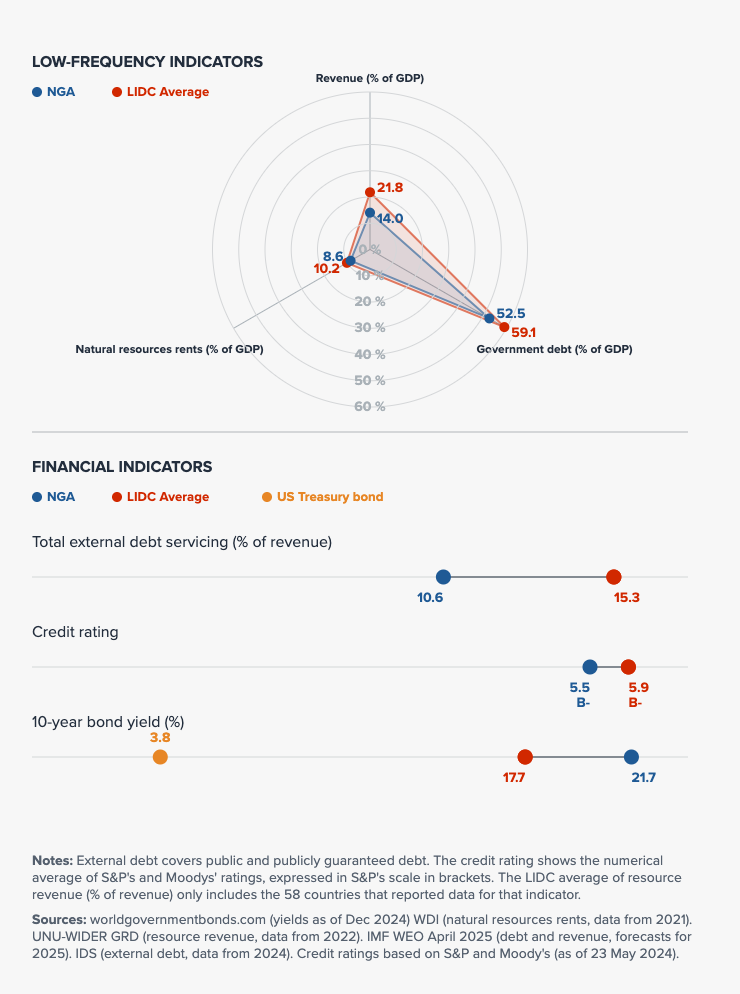
The radar diagram shows low frequency data points linked to government revenue, debt and natural resources rents as a proportion of GDP. The financial indicator graphs show external debt servicing relative to revenue and the country’s latest Debt Sustainability Assessment (DSA) risk rating.

Nigeria’s gross government debt was expected at 52.5% of GDP in 2024, which is 6.5 percentage points (pp) below the low-income developing countries (LIDC) average of 59.1%. The country is expected to collect 14% of GDP in revenue this year, or 7.8 pp lower than the LIDC average of 21.8%.

Nigeria’s external debt servicing in 2024 was expected to reach 10.6% of revenue, which is 4.7 pp below the LIDC average of 15.3%. The country’s credit rating is assessed as in the ‘highly speculative’ grade, similarly to the LIDC average.

Nigeria’s Integrated National Financing Framework (INFF) was launched in September 2022 to support the financing of the 2021-2025 National Development Plan and the attainment of the SDGs. Priority reforms have been identified to enhance tax and policy frameworks, foster a conducive business environment and promote investment among domestic and international investors. These reforms are already yielding significant financial outcomes. Some key achievements include: revenue mobilization and tax administration, investment facilitation for SDG enterprises, investment promotion, improving ease of doing business, investment showcases, support for artisanal and small-scale miners.

Fiscal indicators visualization

Public Finance

Financing needs

SDGs: 10 billion USD per annum required to support the financing of the 2021-2025 National Development Plan and the 8 SDG priorities

NDC: Total: Estimated that US$337 billion will be required for the mitigation and adaptation actions across all sectors from 2026 to 2035

  • US$195 billion (57.8%) for mitigation
  • US$141.5 billion (42.1%) for adaptation
  • US$0.5 billion (0.1%) for ACE elements

Financing strategy

Financing strategy under development

  • National Disaster Risk Finance (DRF) Strategy under development

Expenditures & budgets

  • The Budget Office of the Federation introduced a tool for use by MDAs to better track climate finance
  • However, no institutionalized, federal-level climate budget tagging system to support comprehensive assessments of domestic public climate finance.
  • Analysis of budget data for 6 ministries by Climate Policy Initiative revealed an estimate of USD 300 million in domestic climate finance issued for various budget lines in 2021/22

Debt instruments

  • Nigeria became the first African country to issue a sovereign green bond, raising USD 26 million in 2017
  • Nigeria’s green bond market grew to USD 136 million by 2021
  • USD 250 million sovereign green bond issuance was planned in 2024

International climate finance

  • In 2021/22, multilateral DFI climate finance to Nigeria was USD 1.2 billion, followed by donor governments (USD 224 million), bilateral DFIs (USD 217 million), multilateral climate funds (USD 5 million).
  • In recent years, Nigeria has accessed funding from the GEF, CIF, and GCF
  • Nigeria is set to increase engagement with the GCF via the Development Bank of Nigeria (DBN), which was recently accredited for access to funding in the range of USD 50 million to USD 250 million.

Private Finance & Economy

Policy & Regulatory Measures:

Innovative Instruments:

Initiatives launched by Nigeria to finance the NDCs include:

Energizing Education Programme: operationalised under the Rural Education Agency (REA), this initiative seeks to achieve energy efficiency by increasing and decentralising renewable energy generation. Nigerian Gas Flare Commercialization Programme: aimed at ending gas flaring by 2030 National Gas Expansion Programme: aimed tat delivering over 1 million autogas vehicles Nigerian Erosion and Watershed Management Project (NEWMAP): aimed at assisting subnational governments in different areas of erosion and watershed management

International Investment:

With FDI net inflows of $1.08 billion in 2024, Nigeria's net inflows of FDI is 0.6% of GDP. Nigeria participates in the Global Climate Facility (GCF) and secured total financing of $242.1 million Nigeria has also secured $88.8 million (National) through the Global Environment Facility (GEF)

Domestic Investment:

Major macroeconomic reforms by the new government have instilled buoyancy in the economy and investor confidence is rising.

SDG Investor Map

17 Investment Opportunity Areas (IOAs) that contribute to the government’s NDC priorities and meet SDG needs. The priority IOAs span 3 climate-relevant sectors in Nigeria:

RENEWABLE RESOURCES and ALTERNATIVE ENERGY
INFRASTRUCTURE
FOOD and AGRICULTURE

Development Breakthrough
Policy Brief

Each NDC x SDG Insights policy brief is a focused, country-specific deep dive that builds on the broader Insights report to unpack a single development breakthrough, outlining its policy implications and the SDG-positive actions driving it forward.
Coming soon
Development Breakthrough Policy Brief

Explore other NDC x SDG Insights